
High-salt industrial effluent presents several challenges in wastewater treatment, particularly when the objective is to recover water, manage dissolved salts and achieve Zero Liquid Discharge (ZLD). As dissolved salts become more concentrated, their solubility, precipitation behaviour and tendency to form scale can significantly affect plant performance.
Crystallizers help convert dissolved salts into recoverable solids under controlled process conditions. However, the right crystallizer depends on the salt composition, brine concentration, slurry behaviour, scaling potential and required quality of the recovered solids.
Selecting equipment based only on flow rate or total dissolved solids (TDS) can overlook important differences in how individual salts crystallize and how the resulting slurry behaves.
1. Salt Type and Solubility: Understand What Must Crystallize
Different dissolved salts behave differently as temperature, concentration and solution chemistry change. Some salts crystallize readily through cooling, while others require further evaporation to reach supersaturation.
Mixed-salt effluents can be particularly challenging because individual components may precipitate at different stages.
Key selection considerations include:
Major dissolved salts and their relative concentrations
Solubility at the intended operating temperature
Presence of calcium, sulphates, chlorides and other scaling-forming ions
Common-ion effects and interactions between dissolved species
Potential for selective crystallization or mixed-salt formation
For example, a brine rich in sodium chloride may require a different crystallization strategy from one containing significant calcium sulphate or mixed inorganic salts. Detailed brine analysis and solubility evaluation help establish a suitable operating window.
2. Concentration and Supersaturation: Choose the Right Crystallization Method
Crystallization occurs when a solution becomes supersaturated, creating conditions for dissolved material to form solid crystals.
Depending on the salt and process conditions, supersaturation can be generated through evaporation, cooling or other suitable methods.
Common approaches include:
Evaporative crystallization: Removes additional water to increase salt concentration.
Cooling crystallization: Reduces solubility by lowering the solution temperature.
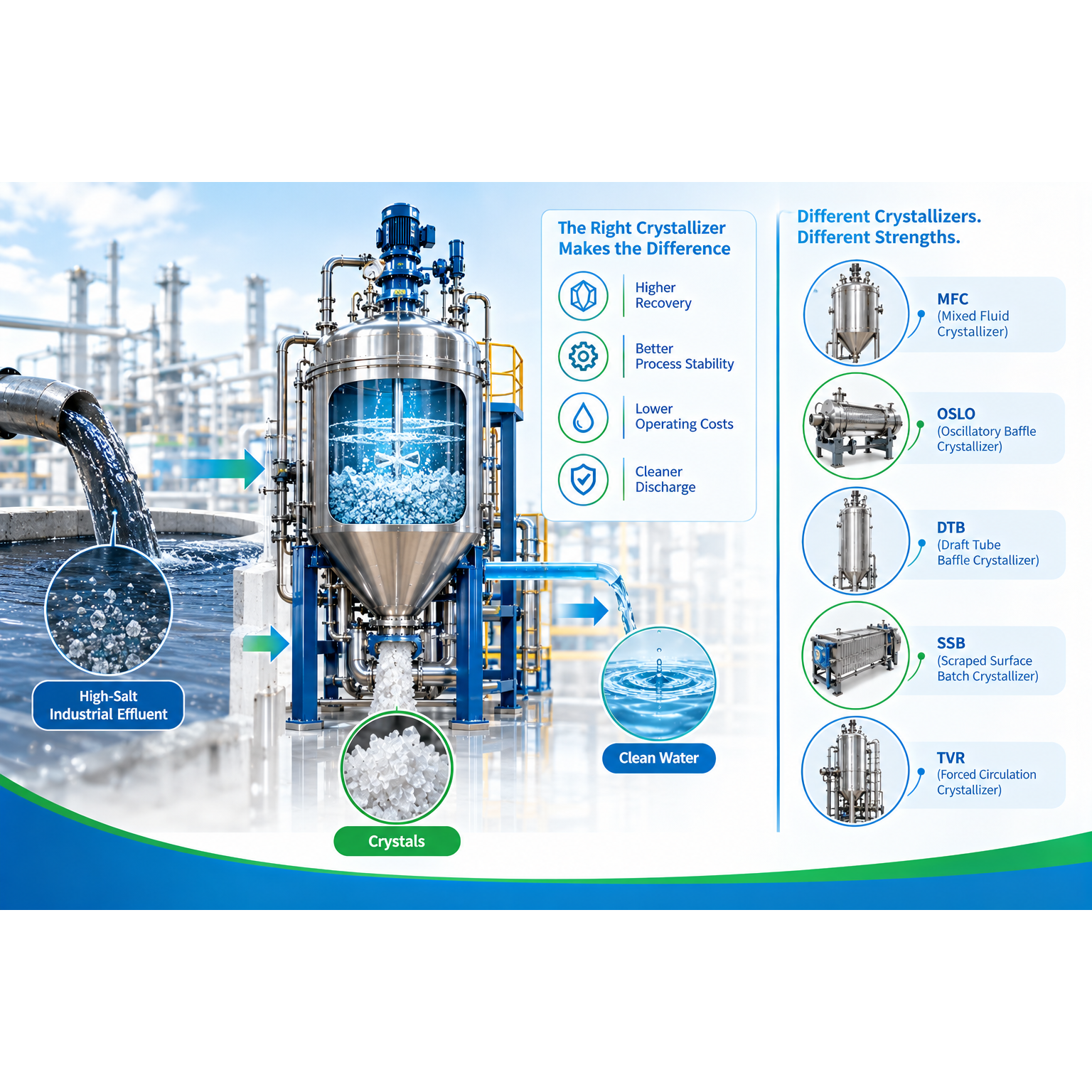
Forced-circulation crystallization: Circulates the slurry through a heat exchanger and crystallizer to manage heat transfer and solids formation.
Draft-tube baffle (DTB) crystallization: Uses controlled circulation and crystal classification to support crystal growth in suitable applications.
The selection depends on salt solubility, operating temperature, energy availability, fouling tendency and the desired crystal characteristics. Forced circulation is often considered for demanding, high-solids or scaling-prone duties, but the final choice requires evaluation of the actual process chemistry.
3. Slurry Behaviour: Account for Viscosity and Solids Loading
As crystallization progresses, the slurry becomes more concentrated in suspended solids. Its flow behaviour can influence circulation, heat transfer, pumping, crystal growth and equipment reliability.
Some slurries remain relatively free-flowing, while others become viscous, abrasive or difficult to circulate.
Important design factors include:
Expected slurry density and solids concentration
Crystal size and particle-size distribution
Viscosity and suspension behaviour
Tendency to agglomerate or form deposits
Pumping requirements and circulation velocity
Fouling and cleaning requirements
For high-solids or difficult-to-handle slurries, the crystallizer design must provide suitable circulation and solids management without causing excessive crystal breakage, erosion or energy consumption.
4. Scaling and Fouling: Protect Continuous Operation
Scale forms when dissolved components precipitate on heat-transfer surfaces, vessel walls or pipelines rather than remaining as suspended crystals.
This can reduce heat-transfer efficiency, restrict flow and increase cleaning frequency. The risk depends on salt chemistry, local temperature, supersaturation and operating conditions.
Design considerations include:
Identification of likely scale-forming compounds
Control of temperature and concentration profiles
Suitable circulation and heat-transfer arrangements
Management of precipitation within the intended crystallization zone
Cleaning provisions and maintenance access
For difficult brines, laboratory testing, solubility modelling and pilot trials can help identify scaling risks before finalising the equipment configuration.
5. Desired Solids Quality: Design for Recovery and Handling
The objective is not simply to produce crystals. The solids must also be suitable for separation, handling and their intended recovery, reuse or disposal route.
Crystal size, shape, purity and residual moisture affect the performance of downstream equipment such as centrifuges, Nutsche filters and other solid-liquid separation systems.
Selection should consider:
Target crystal size and distribution
Salt purity and mixed-salt contamination
Ease of filtration or centrifugation
Mother-liquor retention and washing requirements
Residual moisture and drying requirements
Final solids handling, storage and disposal
Where salt recovery is a priority, crystallizer design must be coordinated with the downstream separation process. Where the solids are intended for disposal, their composition and applicable waste requirements also need consideration.
6. Crystallizer Configurations: Which Type Suits the Process?
The following comparison provides a preliminary selection guide. Actual suitability depends on the salt's solubility behaviour, brine chemistry and process operating conditions.
| Crystallizer configuration | Typically considered for | Key selection consideration |
|---|---|---|
| Evaporative crystallizer | Salts requiring further water removal to reach supersaturation | Energy demand, vapour handling and scale control |
| Forced-circulation crystallizer | High-solids or scaling-prone industrial brines | Circulation duty, heat-transfer design and fouling risk |
| Cooling crystallizer | Salts whose solubility decreases sufficiently with temperature | Cooling requirements and temperature-dependent solubility |
| DTB crystallizer | Applications requiring controlled crystal growth and classification | Crystal-size distribution and circulation behaviour |
| Vacuum crystallizer | Temperature-sensitive or low-boiling-point process requirements where vacuum operation is beneficial | Vacuum-system design, vapour handling and operating stability |
No single configuration is best for every high-salt effluent. In ZLD applications, forced-circulation evaporative crystallization may be appropriate for certain concentrated brines, while cooling or other crystallization methods may suit specific salt-recovery objectives.
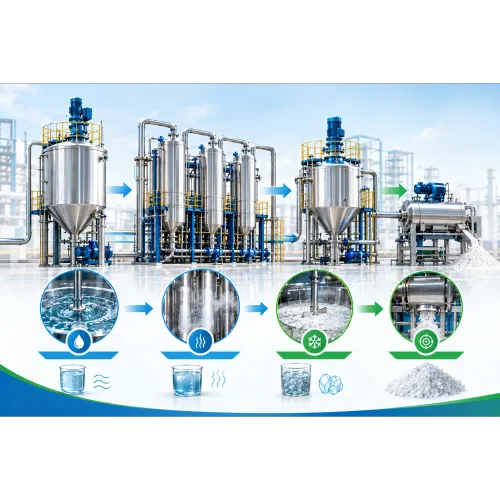
Integrating Crystallization with Evaporation and ZLD
Crystallizer selection should be evaluated alongside the upstream evaporator and downstream solids-separation system.
An evaporator determines the concentration and condition of the brine entering the crystallizer. The crystallizer determines how dissolved salts form solids, while the separation stage recovers those solids from the remaining mother liquor.
A suitable integrated design evaluates:
Evaporator outlet concentration and temperature
Salt precipitation and solubility behaviour
Crystallizer capacity and solids loading
Mother-liquor recycle and impurity accumulation
Energy consumption and scale-management strategy
Downstream filtration, centrifugation and solids handling
This integrated approach can help improve operating stability, water recovery and solids management while reducing avoidable fouling and process interruptions.
Selecting the Right Crystallizer for Industrial Effluent
Crystallizer selection begins with understanding the actual brine—not simply its TDS value. Salt composition, solubility, scaling potential, slurry behaviour, energy availability and the required solids quality all influence the final design.
Centpro Engineering evaluates crystallization as part of the overall industrial evaporation and ZLD process, considering the connection between brine concentration, controlled salt formation and downstream solids recovery.
Planning a crystallization system for high-salt industrial effluent? Share your feed flow rate, TDS, major dissolved salts, operating temperature, target water recovery and required solids quality. These details help determine which crystallizer configuration is worth evaluating for your application.