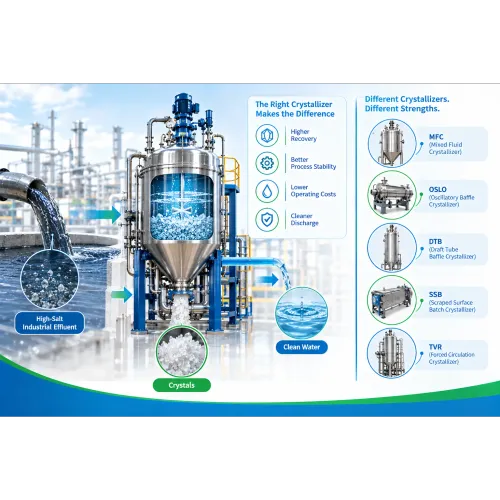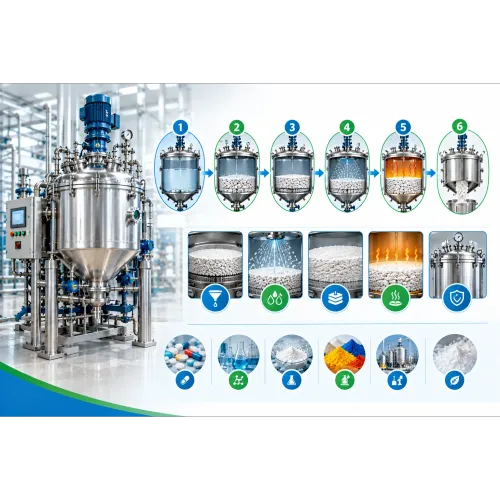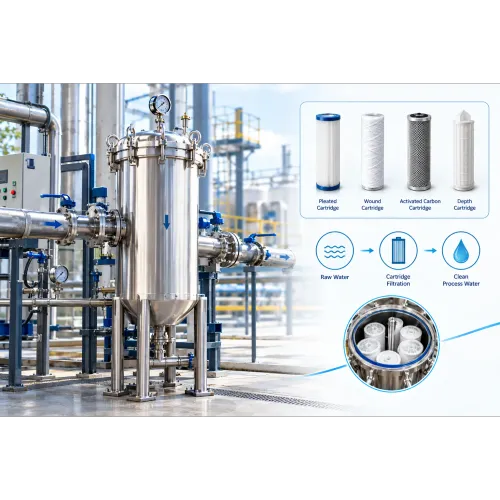

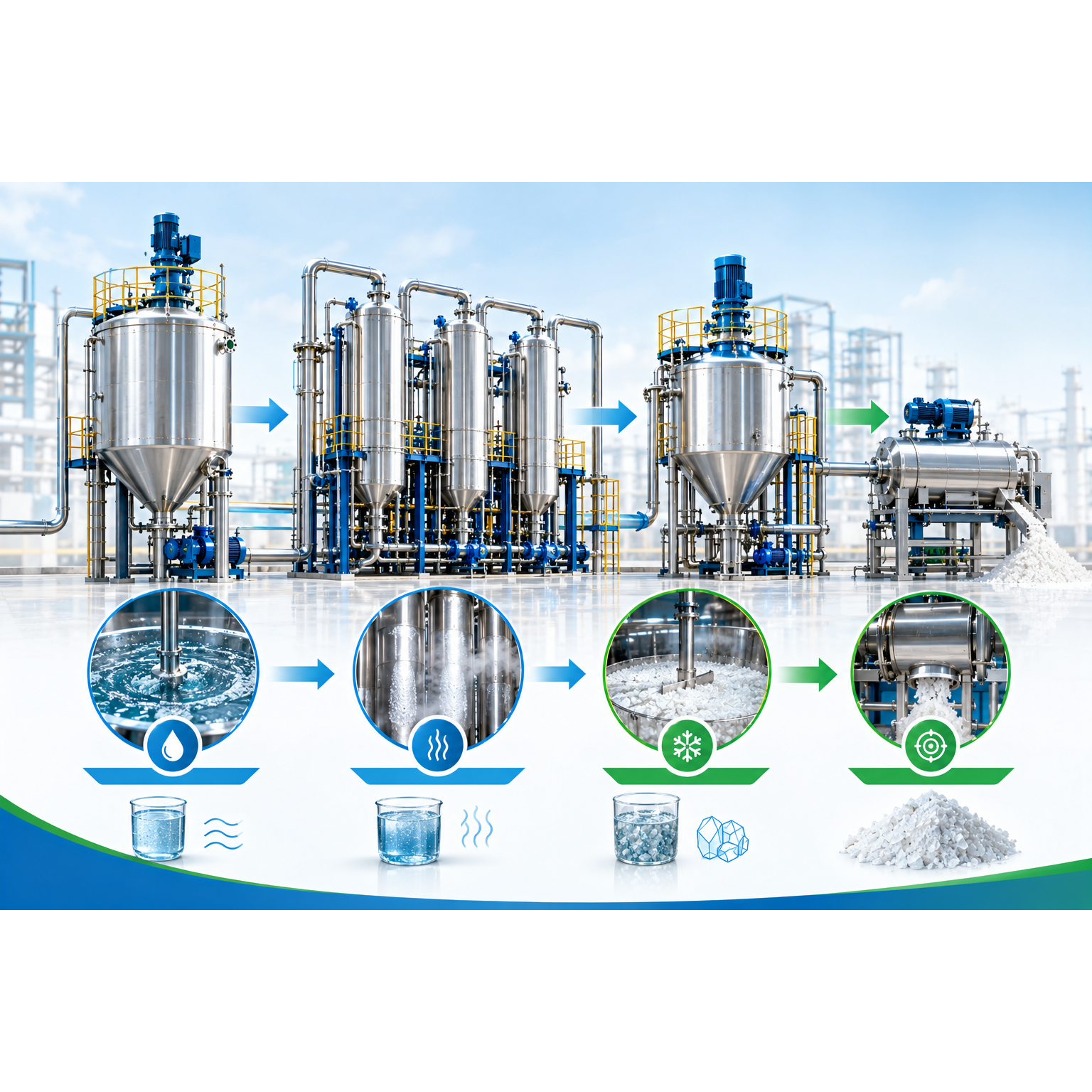
In industrial wastewater treatment and Zero Liquid Discharge (ZLD) systems, brine concentration and salt recovery are closely connected process stages. Evaporators remove water from concentrated streams, while crystallizers promote the formation and recovery of solid crystals from the remaining solution.
Applications in chemical manufacturing, pharmaceutical processing, textile effluent treatment and other high-TDS wastewater streams often require both technologies to achieve the desired concentration, salt recovery and water reuse objectives.
However, selecting an evaporator and crystallizer independently may not deliver the best overall performance. System efficiency depends on how the concentrated brine leaves the evaporator, how it behaves in the crystallizer and how the resulting solids are separated and handled downstream.
1. Brine Concentration: Prepare the Feed for Crystallization
An evaporator removes water from the incoming brine by supplying heat, increasing the concentration of dissolved salts and other non-volatile components.
Depending on the feed characteristics, the system may use a multiple-effect evaporator (MEE), mechanical vapour recompression (MVR/MVRE) or another suitable evaporation technology.
Important design considerations include:
Feed flow rate and total dissolved solids (TDS)
Salt composition and solubility
Boiling point elevation and operating temperature
Scaling, fouling and corrosion potential
Steam consumption and electrical energy requirements
The objective is to concentrate the brine to a suitable level for the next process stage without causing uncontrolled salt deposition or excessive fouling inside the evaporator.
2. The Handoff: Transfer Concentrated Brine to the Crystallizer
The evaporator-to-crystallizer interface is a critical point in the overall process. The evaporator outlet must meet the crystallizer's feed requirements in terms of concentration, temperature, flow rate and chemical composition.
If the brine is too dilute, additional water removal may be required in the crystallizer. If it is too concentrated, unwanted crystallization or salt deposition may occur in transfer lines, valves and heat-transfer surfaces.
Key considerations include:
Outlet concentration and degree of supersaturation
Feed temperature and cooling requirements
Salt solubility at operating conditions
Transfer-line sizing and prevention of premature crystallization
Flow stability and coordination between the two units
A properly designed handoff helps maintain controlled crystallization and reduces the risk of blockages, operating interruptions and inconsistent product quality.
3. Crystallization: Convert Dissolved Salts into Solids
A crystallizer creates conditions under which dissolved salts form solid crystals. This is typically achieved by controlled evaporation, cooling or another suitable method that generates supersaturation.
Once supersaturation is established, crystals can nucleate and grow. The selected operating conditions influence crystal size, shape, purity and the ease of downstream solid-liquid separation.
Important design considerations include:
Salt composition and solubility behaviour
Supersaturation and temperature control
Crystal growth and nucleation
Slurry density and solids concentration
Scale formation and equipment fouling
Crystallizer selection must reflect the actual brine chemistry. Mixed-salt streams, for example, may behave differently from streams dominated by a single salt, affecting both recovery and the characteristics of the final solids.
4. Solid-Liquid Separation: Recover the Crystals
The slurry leaving the crystallizer contains solid crystals suspended in the remaining liquid, often called the mother liquor. A suitable separation stage is required to recover the solids.
Depending on the crystal properties and process requirements, equipment may include centrifuges, Nutsche filters or other suitable filtration and separation systems.
Selection considerations include:
Crystal size and particle-size distribution
Slurry concentration and settling behaviour
Required solids recovery and residual moisture
Mother-liquor retention in the recovered cake
Washing requirements and downstream solids handling
The separated mother liquor may be recycled to the process where appropriate. However, impurities and highly soluble components can accumulate during recycle, so a suitable purge or other impurity-management strategy may be necessary.
5. System Integration: Optimise Energy and Operating Performance
An evaporator and crystallizer should be evaluated as parts of one process system rather than as independent equipment packages.
The concentration achieved in the evaporator influences crystallizer duty, while the crystallizer's operating conditions affect salt recovery, recycle streams and the overall water balance.
Key integration considerations include:
Energy integration: Evaluate steam requirements, vapour reuse and the suitability of MEE or MVR/MVRE technology.
Process balance: Match evaporator throughput with crystallizer capacity and downstream solids-handling requirements.
Scaling control: Identify where salts may precipitate and establish suitable operating conditions.
Recycle management: Assess mother-liquor recycle, impurity accumulation and purge requirements.
Automation and control: Coordinate temperature, pressure, concentration, flow and slurry density across the process.
Materials of construction: Select suitable materials based on brine chemistry, chlorides, temperature and corrosion risks.
A well-integrated system can reduce avoidable energy consumption, improve operational stability and support more consistent salt recovery. Actual savings depend on feed characteristics, process configuration and operating conditions.
6. From Concentrated Brine to Dry Solids: The Role of ZLD
In a Zero Liquid Discharge system, evaporation and crystallization are often combined to recover reusable water and minimise liquid waste discharge.
A typical process sequence is:
Effluent treatment → RO or other suitable pretreatment → Brine concentration → Crystallization → Solid-liquid separation → Salt handling
The precise arrangement depends on the feed composition, recovery objectives and applicable discharge requirements. Not every ZLD system uses all these stages, and the recovered salts may require further treatment or disposal depending on their purity and classification.
The final objective is to manage the liquid and solid streams together, rather than simply maximising the concentration achieved by an individual piece of equipment.
Selecting an Integrated Evaporation and Crystallization System
An effective design starts with a detailed understanding of the feed chemistry, salt solubility, scaling potential, target water recovery, energy availability and final solids-handling requirements.
Centpro Engineering approaches evaporation and crystallization as connected process operations, evaluating the interface between brine concentration, crystal formation, mother-liquor management and downstream solids recovery.
Planning a brine concentration or ZLD system? Share your feed flow rate, TDS, major dissolved salts, operating temperature, required water recovery and expected solid-product characteristics. These details help establish a suitable evaporator–crystallizer configuration for your process.