
Nutsche filtration plays an important role in pharmaceutical and chemical manufacturing by separating solid particles from liquids in process slurries. Applications include the isolation of crystallised products, recovery of chemical intermediates, washing of filter cakes and preparation of solids for downstream processing.
In pharmaceutical, fine chemical and specialty chemical applications, the correct filtration system helps achieve consistent product quality, efficient solids recovery and controlled handling of process materials.
However, selecting a Nutsche filter involves more than choosing a vessel size. Filtration performance depends on slurry characteristics, particle size, filter medium, operating pressure, cake formation, washing requirements, material compatibility and the required final product quality.
1. Filtration and Cake Formation: Understand the Slurry
A Nutsche filter separates suspended solids from a liquid by passing the liquid through a filter medium while retaining the solids inside the vessel.
As filtration progresses, the retained particles form a filter cake on the filter medium. The properties of this cake directly influence filtration rate, liquid recovery and overall cycle time.
Important design considerations include:
Solid particle size and distribution
Slurry concentration and viscosity
Cake thickness and permeability
Filtration area and available pressure differential
Required filtration time and solids recovery
A slurry that forms a compressible or poorly permeable cake may require a different filtration approach from one containing coarse, free-draining particles. Understanding these characteristics helps determine a suitable filtration configuration.
2. Operating Pressure: Match the Filtration Requirement
Nutsche filters can operate using gravity, vacuum or pressure differential, depending on the equipment configuration and process requirements.
The selected operating method affects filtration rate, equipment design and the ability to handle difficult slurries.
Design considerations include:
Required filtration throughput
Available pressure or vacuum
Slurry temperature and viscosity
Filter medium resistance
Vessel design pressure and operating conditions
Insufficient driving pressure can extend filtration time, while excessive pressure may compact certain filter cakes and reduce permeability. The operating conditions should therefore be established through process evaluation and, where necessary, filtration trials.
3. Filter Medium: Ensure Effective Solid Retention
The filter medium retains the required solids while allowing the filtrate to pass through. Its selection depends on particle size, chemical compatibility and the required clarity of the filtrate.
Depending on the application, suitable options may include woven filter cloth, non-woven media or other engineered porous materials.
Selection should consider:
Particle retention requirements
Cloth permeability and filtrate clarity
Chemical and temperature compatibility
Cake release and cleaning requirements
Resistance to blinding or clogging
An unsuitable filter medium may allow fine particles to escape, restrict liquid flow or make cake discharge difficult. Manufacturer specifications and slurry testing can help establish the appropriate medium.
4. Cake Washing: Improve Product Purity
Cake washing is an important stage when the separated solids must meet specific purity requirements. After filtration, a suitable wash liquid is introduced to displace or remove residual mother liquor and soluble impurities retained within the cake.
Washing performance depends on cake structure, wash-liquid properties, distribution, volume and the selected washing method.
Key considerations include:
Required product purity
Residual mother liquor within the cake
Wash-liquid compatibility with the product
Wash-liquid consumption and recovery
Displacement efficiency and washing cycle time
Effective washing can reduce impurity carryover and improve product quality. The washing method should be selected according to the product characteristics and process objectives.
5. Drying Capability: Choose Between a Nutsche Filter and ANFD
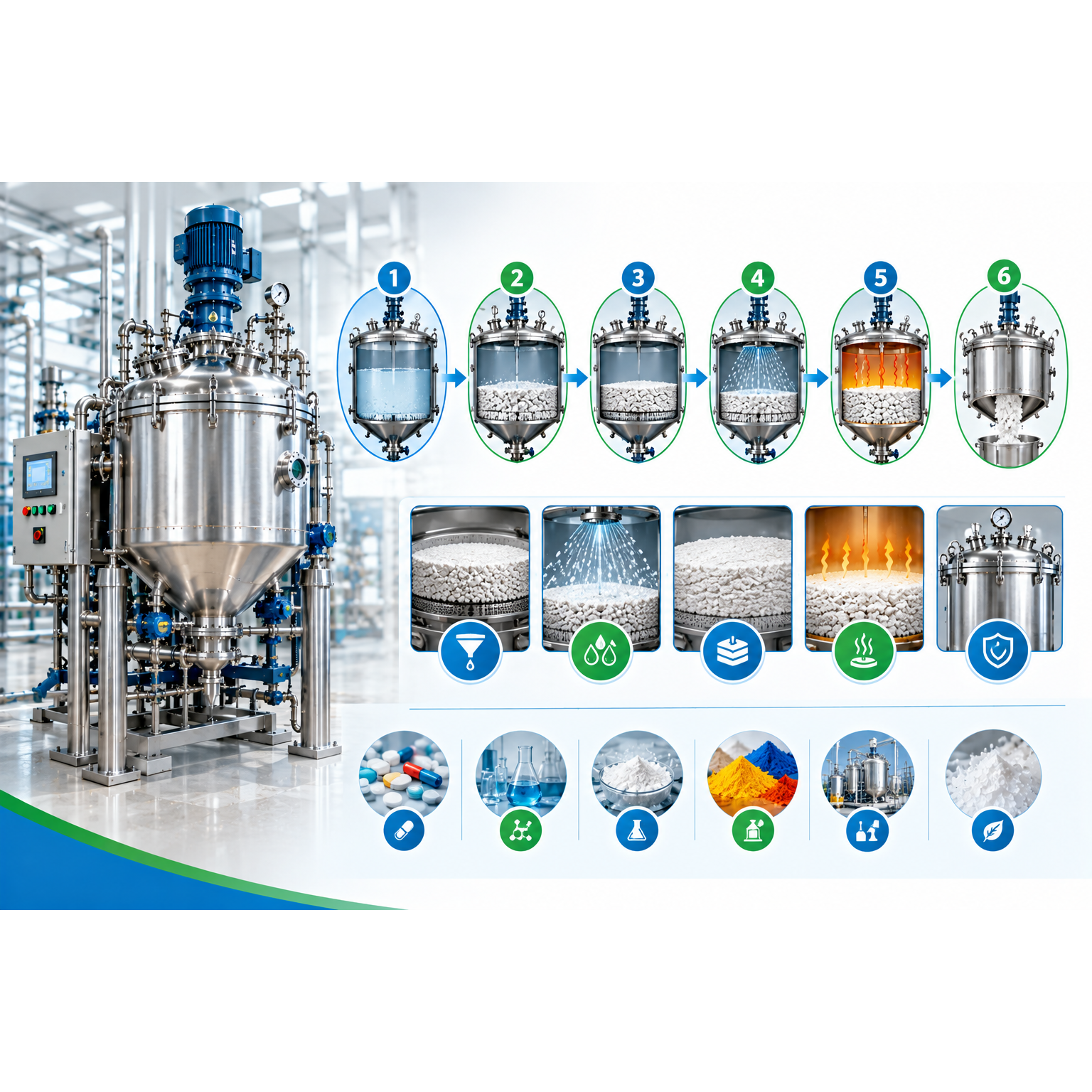
A conventional Nutsche filter performs solid-liquid separation and may support cake washing and dewatering, depending on its design. It does not automatically provide complete drying capability.
An Agitated Nutsche Filter Dryer (ANFD) integrates filtration, cake washing and drying in a single enclosed vessel. Depending on the design, heating surfaces, vacuum and an agitator help remove residual liquid from the cake.
Selection considerations include:
Required final moisture or residual-solvent level
Product sensitivity to heat
Drying temperature and vacuum requirements
Cake mixing and heat-transfer characteristics
Solvent recovery and vapour-handling provisions
For pharmaceutical and fine chemical processes requiring controlled product handling and reduced material transfers, an ANFD may be suitable. Drying performance must be evaluated against the product's thermal characteristics and required endpoint.
6. Containment and Material of Construction: Protect the Product and Process
Pharmaceutical and chemical processes may involve hazardous solvents, potent compounds, corrosive slurries or products sensitive to contamination.
The vessel, filter components, seals and discharge arrangement must be compatible with the process and its operating conditions.
Design considerations include:
Material compatibility with process chemicals
Operating pressure and temperature
Closed handling and operator-exposure control
Cleaning access and product-contact surface requirements
Solvent-vapour management and safe discharge
Applicable pharmaceutical hygiene and containment requirements
Depending on the application, stainless steel grades such as SS304 or SS316L may be considered, along with other suitable materials where corrosion or process conditions require them. Material selection should be based on actual chemical compatibility and mechanical design requirements.
7. Agitation and Discharge: Improve Cake Handling
In an Agitated Nutsche Filter Dryer, the agitator can support cake reslurrying, washing, levelling and drying, depending on its design and operating mode. Some configurations also incorporate mechanisms to assist cake discharge.
The agitator arrangement must be matched to the product's physical properties and the intended process stages.
Important factors include:
Cake consistency and resistance to mixing
Product sensitivity to shear
Uniformity of washing and drying
Discharge arrangement and residual product hold-up
Cleaning, maintenance and operational safety
Appropriate design can improve product recovery and reduce manual handling, particularly when processing sticky, cohesive or high-value materials.
Selecting the Right Nutsche Filtration System
An effective Nutsche filtration system is designed around the complete solid-liquid separation requirement. A system intended for simple chemical precipitation may have different requirements from one used for pharmaceutical crystal isolation, high-purity intermediates or solvent-based processing.
Centpro Engineering evaluates application-specific factors such as slurry properties, filtration area, operating conditions, filter medium, washing requirements, vessel material and downstream processing needs to determine a suitable equipment configuration.
Depending on the process, the solution may involve a conventional Nutsche filter or an Agitated Nutsche Filter Dryer integrating filtration, washing and drying operations.
Planning a Nutsche filtration system for your process? Share your slurry composition, solid particle characteristics, batch size, operating temperature and pressure, required product purity, washing requirements and target final moisture content. Centpro Engineering can evaluate a suitable Nutsche filter configuration for your application.