
Not every industrial effluent can be concentrated effectively using the same evaporator configuration. Feed viscosity, suspended solids, fouling tendency, heat sensitivity, concentration range and crystallization behavior all influence evaporator selection.
For complex wastewater and process streams, the right evaporator is selected around the behavior of the liquid—not simply its flow rate.
Falling-Film Evaporators: Best for Clean, Low-Viscosity Feeds
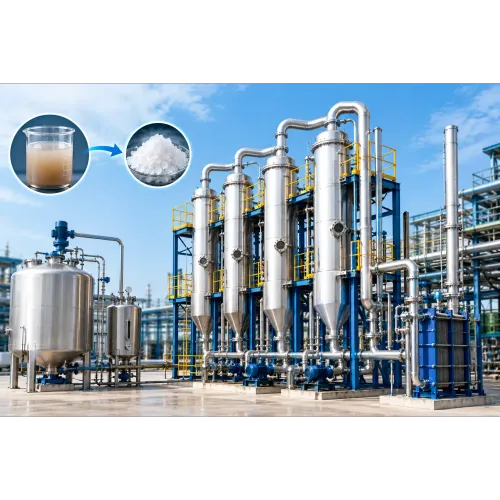
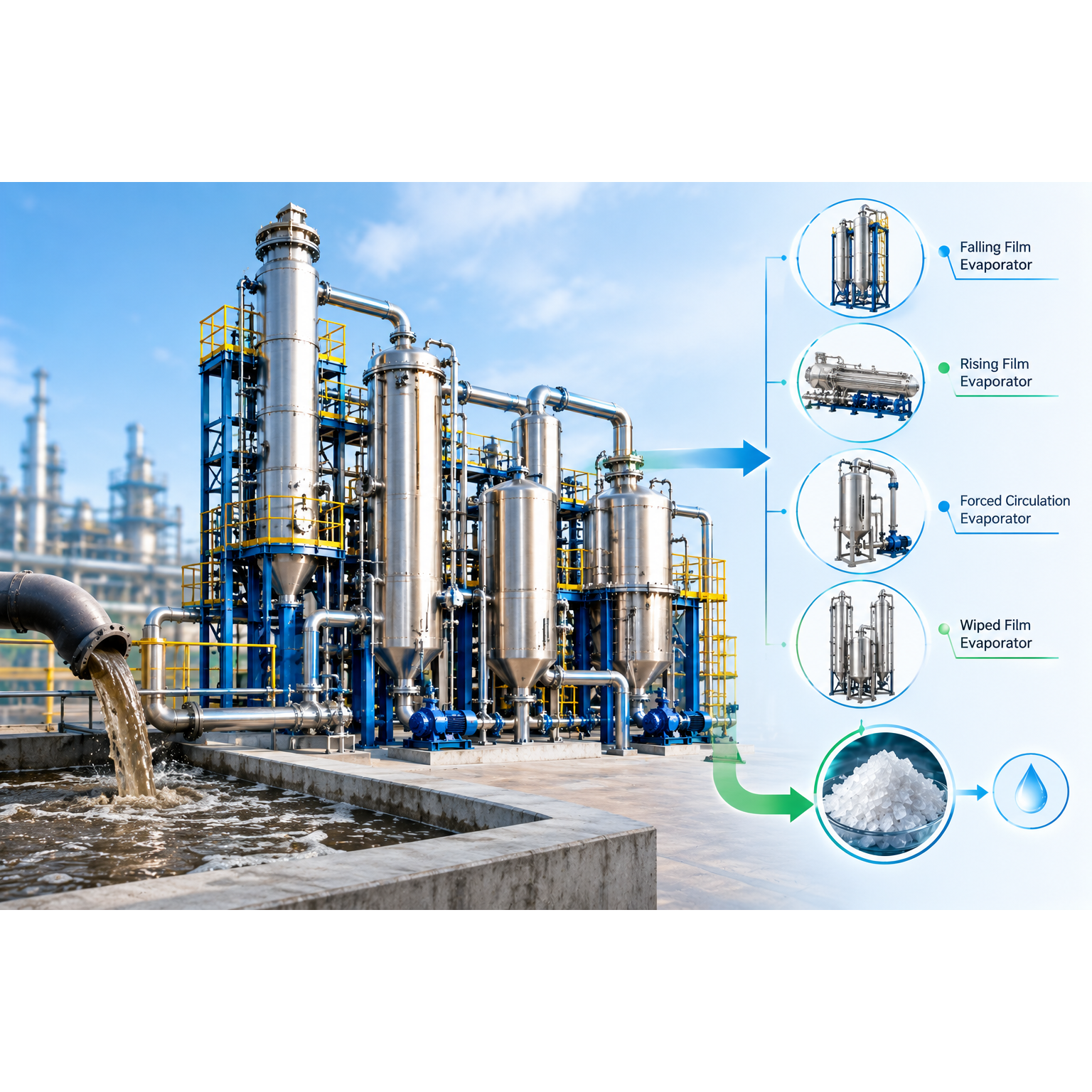
In a falling-film evaporator, liquid is distributed over the inside surface of vertical heating tubes and flows downward as a thin film while water evaporates.
The thin film provides efficient heat transfer and relatively short residence time, making the configuration attractive for:
- Low-viscosity solutions
- Relatively clean feeds
- Heat-sensitive products
- High evaporation rates
- Applications where compact equipment is beneficial
However, falling-film systems become more challenging when the feed contains significant suspended solids, rapidly increasing viscosity or severe scaling components. Poor liquid distribution can also create dry areas and localized fouling.
Forced-Circulation Evaporators: For Difficult and High-Concentration Liquids
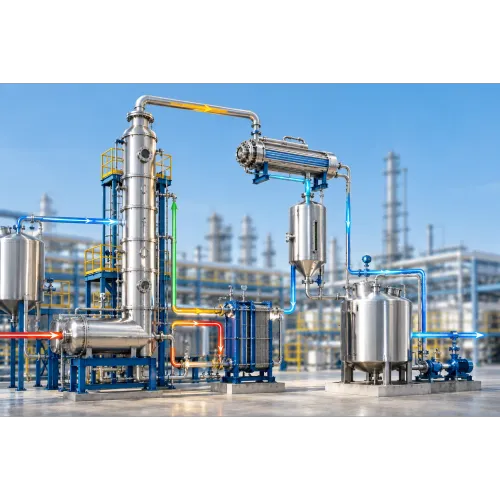
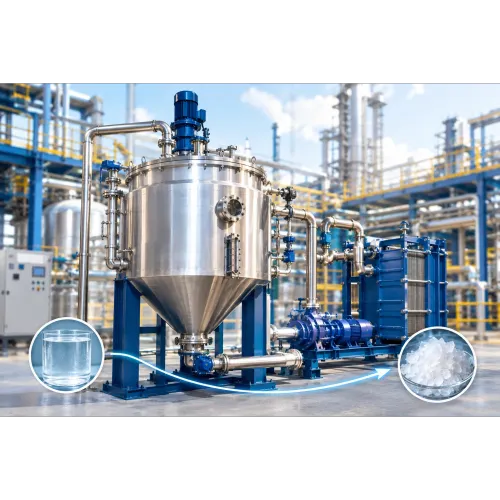
Forced-circulation evaporators continuously circulate the process liquid through the heat exchanger using a pump. Evaporation generally occurs in a separate flash/separation vessel.
This configuration is particularly useful when the liquid becomes difficult to circulate through natural circulation or thin-film equipment.
It can handle:
- Higher viscosity
- High dissolved-solids concentration
- Suspended solids
- Scaling-prone feeds
- Concentrated brines
- Liquids approaching crystallization
The high circulation velocity helps maintain heat-transfer performance and reduces the risk of localized deposition on the heating surface.
For demanding ZLD applications, forced circulation can therefore be an important configuration for the later concentration stages.
Rising-Film Evaporators: Short Residence Time and Low Viscosity
In a rising-film evaporator, vapor generated inside the heating tubes creates upward movement of the liquid, producing a rising film.
This design can provide good heat transfer with relatively short residence time and can be considered for:
- Low-viscosity feeds
- Heat-sensitive materials
- Relatively clean solutions
- Applications requiring rapid evaporation
However, as viscosity and solids loading increase, the hydrodynamic conditions become less favorable. Consequently, rising-film systems are generally less suited to heavily fouling or highly concentrated effluents.
Wiped-Film and Agitated Thin-Film Systems
When conventional evaporators struggle with very viscous, heat-sensitive or fouling-prone streams, mechanically assisted thin-film technologies can become relevant.
A rotor continuously spreads the liquid across the heated surface, maintaining a thin film and improving heat transfer while limiting residence time.
These systems can be considered for difficult concentrated streams where conventional falling-film operation becomes impractical.
The Feed Determines the Configuration
A practical comparison looks like this:
| Feed Characteristic | Suitable Configuration |
|---|---|
| Low viscosity, clean feed | Falling film |
| Low viscosity, heat-sensitive feed | Falling/rising film |
| High TDS and concentrated brine | Forced circulation |
| Suspended solids | Forced circulation / suitable specialized design |
| High viscosity | Forced circulation / thin-film systems |
| Severe fouling tendency | Forced circulation or mechanically assisted systems |
| Heat-sensitive concentrated liquid | Short-residence-time thin-film systems |
| Near-crystallization conditions | Forced circulation / crystallization-oriented design |
The table is a starting point—not a fixed selection rule. Actual configuration depends on feed chemistry, concentration profile, solubility, boiling-point elevation, scaling behavior, heat-transfer characteristics and required final concentration.
Evaporator Selection Is a Process Engineering Decision
For complex industrial effluent, selecting the evaporator before understanding the process can result in excessive fouling, poor heat transfer, high energy consumption and difficult operation.
At CentPro Engineering, evaporator selection can be evaluated around the complete process—from feed characterization and concentration stages to heat integration, MEE/MVR configuration, final concentration and downstream ATFD or crystallization.
Planning an evaporation system for complex industrial effluent? Share your feed flow rate, TDS, major salts, suspended solids, viscosity, operating temperature and required final concentration. CentPro can evaluate the appropriate evaporator configuration and integrated thermal ZLD approach for your process.