

Industrial Heat Exchanger Manufacturer in Pune
An industrial heat exchanger transfers thermal energy between two fluids without directly mixing them. It is used for process heating, cooling, condensation, vaporisation and heat recovery across chemical, pharmaceutical, petrochemical and other process industries.
Centpro Engineering Pvt. Ltd., based in Hadapsar, Pune, designs and supplies shell and tube heat exchangers, condensers and related thermal equipment for industrial process applications. Each exchanger must be matched to its operating duty, fluid properties, pressure and temperature requirements, fouling characteristics and material compatibility.
Rather than selecting equipment by size alone, heat exchanger design begins with understanding the process. Correct sizing and mechanical configuration help establish the required heat-transfer performance while accounting for pressure drop, maintenance access and operating conditions.
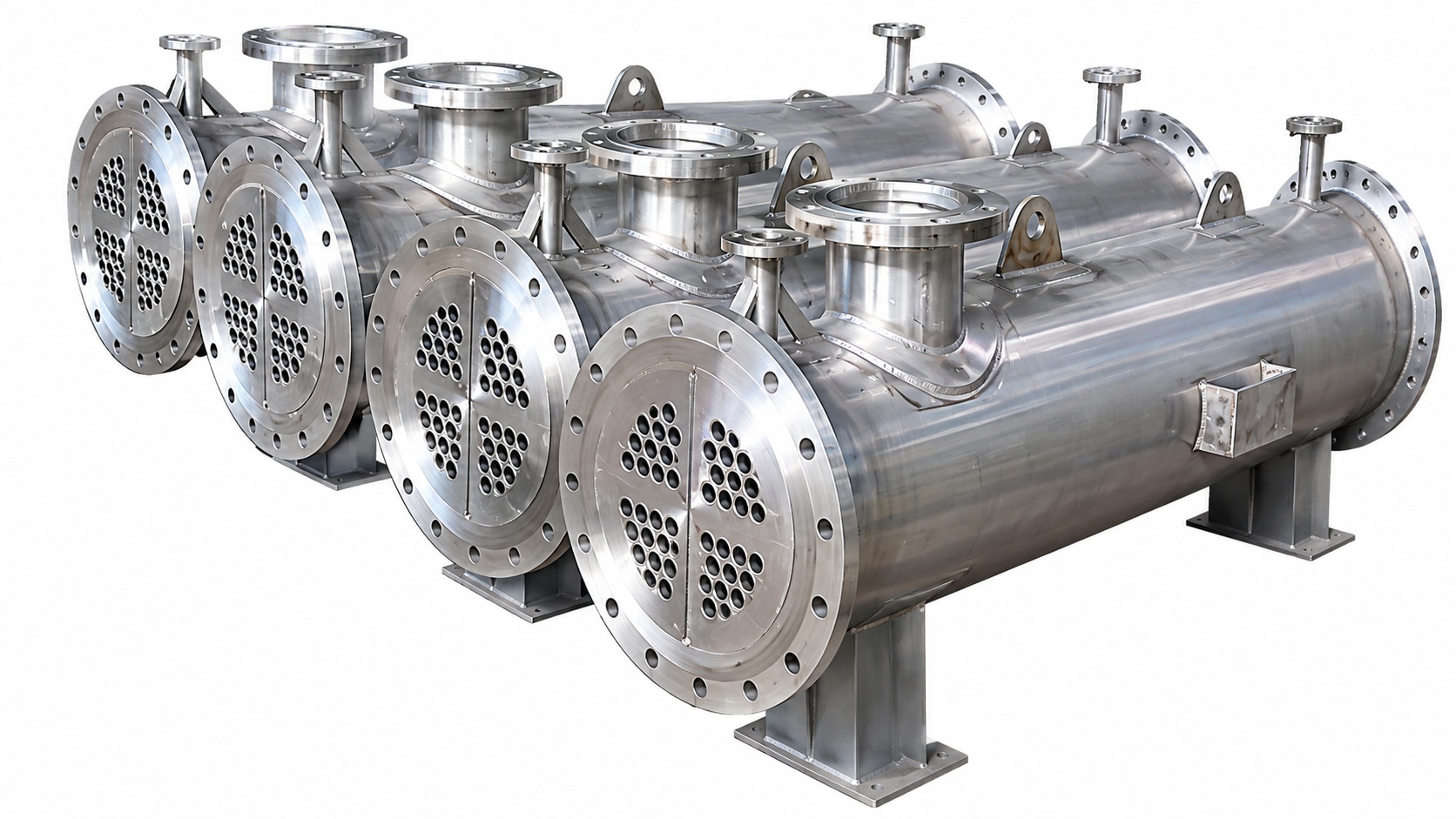
Heat Exchanger Design: Thermal Duty, Temperature Approach and Fouling
Key Design Parameters
1. Thermal duty and operating temperatures
Thermal duty represents the amount of heat transferred per unit time. It is determined from the process flow rates, inlet and outlet temperatures, and relevant fluid properties. Both hot-side and cold-side conditions must be considered to establish the required heat-transfer area.
2. Log mean temperature difference (LMTD)
The log mean temperature difference represents the effective temperature driving force across the exchanger. For a given thermal duty and overall heat-transfer coefficient, a smaller temperature difference generally requires more heat-transfer area. Multipass and crossflow arrangements may require an appropriate correction factor.
3. Fluid properties
Density, viscosity, specific heat, thermal conductivity and phase behaviour influence heat transfer and pressure drop. Viscous liquids may require particular attention to flow distribution and heat-transfer limitations.
4. Fouling tendency
Scaling, suspended solids, polymerisation and other deposits can reduce heat-transfer performance over time. The design should consider expected fouling resistance, cleaning methods, operating intervals and the consequences of deposits on pressure drop.
5. Pressure drop
Increasing fluid velocity can improve heat transfer, but it can also increase pressure drop and pumping requirements. The design must balance thermal performance with the allowable pressure drop on both sides of the exchanger.
6. Condensation and boiling duties
Condensers, reboilers and other phase-change exchangers require attention to vapour loading, condensate drainage, non-condensable gases, heat-transfer behaviour and operating pressure. These requirements differ from those of single-phase heating and cooling duties.
Shell and Tube Heat Exchanger Construction and Selection
Shell and tube heat exchangers are widely used in process plants because they can be designed for a broad range of operating pressures, temperatures and fluid services. A typical unit consists of a shell, tube bundle, channel or bonnet, tube sheets, baffles and associated connections.
The appropriate mechanical configuration depends on thermal expansion, cleaning requirements, operating conditions and the nature of the process fluids.
Fixed Tube Sheet Heat Exchanger
A fixed tube sheet arrangement can offer a relatively simple and economical construction. However, thermal expansion differences between the shell and tubes must be assessed, and mechanical access to the shell side may be limited.
U-Tube Heat Exchanger
A U-tube bundle accommodates differential thermal expansion through its bent tube arrangement. Tube-side mechanical cleaning may be more difficult near the bends, so this configuration should be evaluated against the fluid's fouling characteristics and maintenance requirements.
Floating Head Heat Exchanger
A floating head arrangement allows the tube bundle to be removed in suitable designs, improving access for inspection and mechanical cleaning. It may be considered for services where bundle removal is important, subject to the required mechanical design and cost.
Baffles and Flow Arrangement
Baffles guide shell-side flow across the tube bundle and influence heat transfer, vibration risk and pressure drop. Their spacing and arrangement should be selected as part of the overall thermal and mechanical design rather than independently.
The choice of shell-side and tube-side fluids also matters. Tube-side placement may be advantageous for selected corrosive, high-pressure or fouling streams because the tubes can be more accessible for cleaning. The final arrangement depends on the complete process and mechanical requirements.
Materials of Construction and Corrosion Resistance
Material selection is critical when handling corrosive process liquids, high-temperature fluids or services containing chlorides and other aggressive constituents.
Depending on the application, materials may include carbon steel, stainless steel grades, duplex or super duplex stainless steel, titanium and other suitable alloys. Selection should consider chemical concentration, temperature, pressure, erosion, corrosion mechanisms and the expected service life.
Potential risks such as pitting, crevice corrosion, galvanic effects and chloride stress corrosion cracking should be assessed where relevant. No single material is suitable for every corrosive service; the choice should be supported by process data and an appropriate corrosion assessment.
When Should Other Heat Exchanger Types Be Considered?
Although shell and tube construction is widely used in industrial process plants, other exchanger types may suit particular duties.
Plate heat exchangers: Can provide high heat-transfer efficiency and a compact footprint for compatible services. Gasket materials, pressure and temperature limits, channel blockage and fouling must be considered.
Double-pipe heat exchangers: May suit smaller duties or applications requiring a straightforward arrangement.
Spiral heat exchangers: Can be considered for selected fluids with fouling or solids-handling challenges, subject to service conditions and available design options.
Coil heat exchangers: May suit particular vessel heating or cooling applications.
The appropriate equipment depends on the thermal duty, fluid properties, operating envelope, maintenance strategy and lifecycle cost. Selection should follow the process requirements rather than a preference for one exchanger type.
Key Benefits of Properly Designed Industrial Heat Exchangers
A correctly selected and designed heat exchanger can support:
Thermal performance matched to the specified process duty.
Heating, cooling, condensation and selected heat-recovery applications.
Material selection suited to fluid chemistry and operating conditions.
Mechanical arrangements aligned with inspection and cleaning requirements.
Integration with evaporators, distillation columns, reactors and solvent recovery systems.
Opportunities to reduce utility consumption through economically justified heat recovery.
Design and fabrication appropriate to the specified pressure and temperature conditions.
Actual performance depends on the process data, design, installation, utility conditions and maintenance practices.
Industrial Applications
Centpro's heat exchanger and condenser solutions can be considered for duties such as:
Process condensers: Condensation of process vapours and selected vent streams.
Distillation systems: Reboilers, overhead condensers and feed preheaters.
Chemical reactors: Heating and cooling duties for compatible process fluids.
Evaporator systems: Condensers, feed preheaters and other thermal integration duties.
Solvent recovery plants: Condensation and cooling of recovered solvent vapours.
Industrial liquid heating and cooling: Thermal conditioning of process water, thermal fluids and compatible chemical streams.
Effluent treatment systems: Heat transfer associated with evaporation and other suitable treatment processes.
Related Process Equipment
Heat exchangers often form part of a wider process system. Explore related Centpro equipment:
Industrial Distillation Column: Reboilers and condensers for distillation systems.
Industrial Chemical Reactor: Reactor heating and cooling requirements.
MEE Multiple Effect Evaporator: Condensers, preheaters and heat integration in evaporation systems.
Industrial Solvent Recovery System: Condensation and cooling duties for solvent recovery.
Industrial Cartridge Filter Housing: Filtration upstream of compatible process equipment.
Why Choose Centpro Engineering?
Centpro Engineering approaches heat exchangers as part of the process system they serve. Design and equipment selection take into account thermal duty, operating pressures and temperatures, fluid compatibility, fouling behaviour, pressure drop and maintenance requirements.
Based in Hadapsar, Pune, Centpro supports industrial process equipment projects through engineering, fabrication and supply, with installation or commissioning support according to the agreed project scope. Heat exchangers can be considered alongside evaporation, distillation, reactor and solvent recovery systems where the overall process requires coordinated thermal equipment.
Frequently Asked Questions
1. What information is required to size an industrial heat exchanger?
The main inputs include fluid names and properties, flow rates, inlet and required outlet temperatures, operating and design pressures, allowable pressure drops, fouling expectations and any relevant material or cleaning constraints. For phase-change duties, additional information about vapour composition, condensation or boiling conditions may be required.
2. When should I choose a shell and tube heat exchanger over a plate heat exchanger?
Shell and tube exchangers may be suitable for higher-pressure or higher-temperature duties, certain fouling services and applications requiring particular mechanical configurations. Plate exchangers can be attractive for compact, efficient heat transfer in compatible services. The correct choice depends on the actual operating conditions, fluid characteristics and maintenance requirements.
3. What is a fouling factor in heat exchanger design?
The fouling factor is an allowance for the additional thermal resistance expected from deposits that develop on heat-transfer surfaces during operation. The value should reflect the fluid, operating conditions and expected maintenance practices.
4. Which material is suitable for chloride-containing fluids?
The suitable material depends on chloride concentration, temperature, pH, oxygen conditions, pressure and other contaminants. Stainless steel, duplex alloys, titanium or other materials may be considered after assessing the specific corrosion risks.
5. Can industrial heat exchangers be cleaned?
Yes, depending on the design and deposits involved. Cleaning may use suitable chemical methods or mechanical methods. Mechanical access is influenced by the construction, tube arrangement and whether the bundle can be removed. Cleaning procedures must be compatible with the materials and process.
6. Can a heat exchanger reduce energy consumption?
It can help reduce utility demand when heat from a hot process stream is recovered to preheat another stream or serve another suitable duty. The opportunity depends on temperature levels, operating schedules, fouling, additional pressure drop and the economics of the proposed heat integration.
Enquire About an Industrial Heat Exchanger
Share your process fluids, flow rates, inlet and outlet temperatures, operating pressure, design conditions and expected fouling characteristics. Centpro Engineering can use these details to begin evaluating a suitable heat exchanger configuration for your application.
Centpro Engineering Pvt. Ltd.
Email: sales@centpro.com
Phone: +91 80-4275-4893
WhatsApp: +91 70660 14007
Location: Hadapsar, Pune, Maharashtra, India
