

Industrial Chemical Reactor Manufacturer in Pune
An industrial chemical reactor is a vessel in which chemical reactions take place under controlled operating conditions. Temperature, pressure, mixing, residence time and material compatibility all influence reaction performance, product quality and process safety.
Centpro Engineering Pvt. Ltd., based in Hadapsar, Pune, designs and supplies industrial process equipment, including chemical reactors for suitable chemical, pharmaceutical and specialty chemical applications. Reactor configuration is selected according to the reaction chemistry, batch volume, operating conditions, agitation requirements and materials of construction.
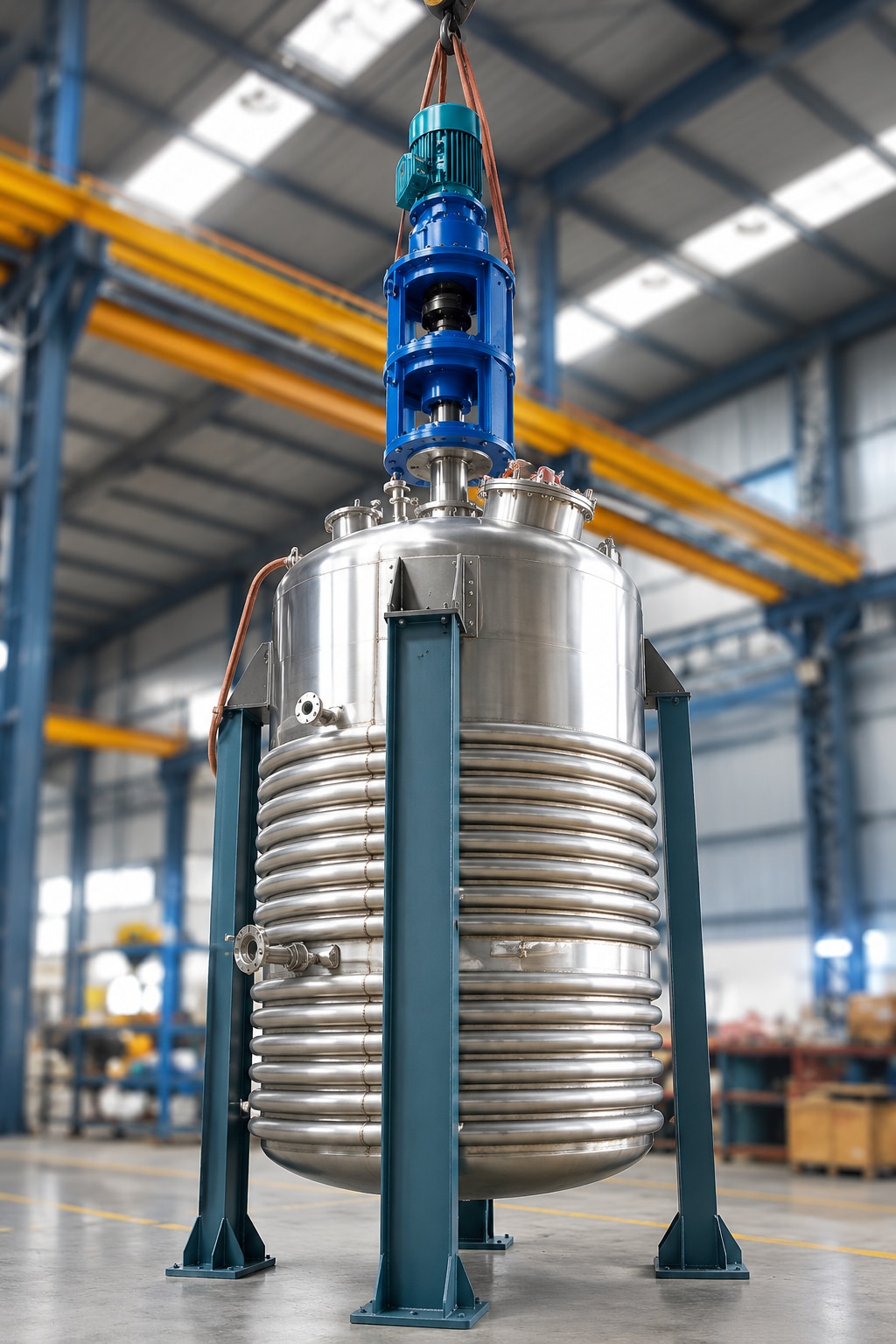
Depending on the process, a reactor system may include a jacketed vessel, agitator, baffles, heating and cooling connections, instrumentation, charging and discharge arrangements, and connections to condensers or downstream separation equipment.
The objective is to develop a reactor configuration that addresses the actual process requirements rather than relying on vessel volume alone.
Chemical Reactor Design: Mixing, Heat Transfer, Pressure and Materials
1. Agitation and Mixing Performance
Agitation affects reactant distribution, heat transfer, solids suspension and the consistency of the reaction. The agitator must be selected according to the fluid's viscosity, phase behaviour, required mixing intensity and process objective.
Common configurations include:
Axial-flow impellers: Promote bulk circulation and may be suitable for blending and solids suspension.
Radial-flow impellers: Provide higher local shear and may be suitable for selected dispersion duties.
Anchor agitators: Support mixing of viscous materials and can help move material near the vessel wall.
Helical agitators: May suit highly viscous materials where conventional impellers provide insufficient circulation.
Baffles, impeller diameter, rotational speed, vessel geometry and agitator power also influence performance. Gas-liquid reactions and solid suspensions may require additional attention to mass transfer and mixing behaviour.
Poor mixing can contribute to local temperature differences, concentration gradients and inconsistent product quality. Agitator selection should therefore be based on the complete process duty.
2. Heating and Cooling System Design
Many chemical reactions release heat, while others require continuous heating or controlled cooling. The reactor's thermal design must account for the heat generated or absorbed by the reaction, the batch cycle and the available heating or cooling utilities.
Possible arrangements include:
Conventional jackets: Provide a heat-transfer surface around the vessel.
Dimple jackets: Offer an alternative jacket construction, subject to the required mechanical and thermal design.
Half-pipe coil jackets: Provide a jacket arrangement that can be suitable for selected pressure and heat-transfer requirements.
Internal coils: Add heat-transfer area where the process and vessel arrangement permit.
External recirculation heat exchangers: May be considered for selected duties where an external loop is appropriate.
Utilities may include steam, hot water, thermal fluid, cooling water or chilled media, depending on the required operating temperatures and design conditions.
For exothermic reactions, cooling capacity must be assessed against the maximum credible heat-release rate. Reaction-hazard assessment and suitable process safeguards are particularly important where uncontrolled temperature rise could lead to dangerous pressure or reaction conditions.
3. Operating Pressure and Vacuum Requirements
Some reactions operate near atmospheric pressure, while others require pressurised operation or vacuum. These conditions affect vessel thickness, closures, nozzles, seals, instrumentation and protective systems.
For pressure or vacuum service, the design basis should define the operating and design pressure, temperature range, applicable design code and relevant load cases. Pressure relief and other protective measures must be selected through an appropriate hazard assessment.
Vacuum service also requires consideration of external-pressure resistance and the possibility of vessel buckling. A vessel suitable for atmospheric operation should not be assumed suitable for vacuum or pressurised duty without a corresponding mechanical design assessment.
4. Material of Construction and Corrosion Resistance
The material must remain compatible with the reactants, intermediates, final product and cleaning chemicals throughout the operating cycle.
Common material options may include:
Stainless steel 304, 316 and 316L: Used in many chemical and pharmaceutical applications, subject to chemical compatibility.
Duplex and super duplex stainless steels: Considered for selected services where their corrosion and mechanical properties are appropriate.
Nickel alloys, including suitable grades of Hastelloy: May be required for certain aggressive chemical environments.
Glass-lined or other lined vessels: May be considered for compatible corrosive services, subject to temperature, pressure, thermal shock and mechanical limitations.
Material selection should include the vessel, agitator, shaft, impeller, seals, gaskets, nozzles and other wetted components. Corrosion assessment is especially important for chloride-containing and strongly acidic services.
5. Reactor Selection Checklist
Before specifying an industrial chemical reactor, establish:
Required working volume and batch size.
Reaction chemistry and batch cycle time.
Operating and design temperature and pressure.
Heat of reaction and cooling requirements, where applicable.
Fluid viscosity and whether solids or gases are present.
Corrosivity of the reactants, intermediates and products.
Agitation and mixing requirements.
Cleaning, product changeover and maintenance needs.
Pharmaceutical hygiene or applicable cGMP requirements, where relevant.
Ancillary equipment such as condensers, receivers, filters and solvent recovery systems.
These inputs help establish a more suitable reactor configuration and reduce the risk of under-specification.
Key Benefits of a Properly Designed Chemical Reactor
A reactor designed around the process requirements can provide:
Vessel configuration matched to the required working volume and operating conditions.
Agitation suited to fluid viscosity, blending and solids suspension.
Heating and cooling arrangements selected for the process duty.
Materials chosen for chemical compatibility and service conditions.
Provision for suitable instrumentation and process controls.
Integration with condensers, distillation columns, filters and solvent recovery equipment.
A mechanical design basis appropriate to the specified pressure, temperature and applicable code.
Performance and suitability depend on the process data, detailed engineering, fabrication quality, installation and operating practices.
Industrial Applications
Industrial chemical reactors are used across a range of process industries, including:
Pharmaceutical and API manufacturing: Reaction stages for intermediates and active pharmaceutical ingredient processes.
Specialty and fine chemicals: Batch synthesis and controlled chemical processing.
Agrochemicals: Production of selected chemical intermediates and formulations.
Polymers and resins: Reaction, blending and processing duties for compatible materials.
Dyes and pigments: Chemical synthesis and selected batch processing applications.
Neutralisation and dissolution: Controlled mixing and reaction between compatible process streams.
Chemical process plants: Reaction stages integrated with heat transfer, filtration and separation systems.
The final reactor design should reflect the specific chemistry, product requirements and applicable process-safety obligations.
Related Process Equipment
Chemical reactors often operate as part of a wider process system. Explore related Centpro equipment:
Industrial Heat Exchanger: Reactor heating and cooling, process condensers and heat-transfer duties.
Industrial Distillation Column: Separation and purification after suitable reaction stages.
Industrial Nutsche Filter: Solid-liquid separation for compatible process products.
Industrial Solvent Recovery System: Recovery of suitable solvents from process streams.
Industrial Scrubber and Gas Treatment System: Treatment of selected reactor vent gases based on their composition and treatment requirements.
Why Choose Centpro Engineering?
Centpro Engineering approaches reactor projects by considering the process chemistry, operating conditions, agitation, heat-transfer requirements and material compatibility together.
Based in Hadapsar, Pune, Centpro provides industrial process equipment through engineering, fabrication and supply, with installation or commissioning support according to the agreed project scope. Where required, reactor projects can be evaluated alongside compatible heat exchangers, condensers, filters, distillation equipment and solvent recovery systems.
This process-oriented approach helps establish the equipment requirements within the context of the wider manufacturing operation.
Frequently Asked Questions
1. What information is required to design an industrial chemical reactor?
The main inputs include the reaction description, batch volume, operating and design temperature and pressure, fluid viscosity, solids content, chemical compatibility, mixing requirements and cleaning needs. Heat-release information and a reaction-hazard assessment are important for exothermic reactions.
2. How is the agitator selected for a chemical reactor?
Agitator selection depends on viscosity, vessel geometry, required mixing intensity, solids suspension, gas dispersion and the reaction's sensitivity to mixing conditions. Impeller type, speed, power and baffle arrangement must be considered together.
3. Should I choose stainless steel or a glass-lined reactor?
Stainless steel is suitable for many chemical services, but compatibility depends on the exact chemistry and operating conditions. Glass-lined or alloy construction may be considered for more corrosive services. The decision should account for corrosion, temperature, pressure, thermal shock, cleaning and maintenance.
4. Can a chemical reactor operate under pressure or vacuum?
Yes, provided the vessel is specifically designed for the required conditions under an applicable design code. Pressure protection, vacuum resistance, instrumentation and other safeguards must be addressed in the design.
5. Can a chemical reactor be integrated with distillation or solvent recovery?
Yes. A reactor can be configured with appropriate connections and compatible ancillary equipment, such as condensers, receivers, distillation columns and solvent recovery systems. The arrangement depends on the process sequence, vapour characteristics and operating conditions.
6. How do I determine the correct reactor capacity?
Capacity depends on the required batch volume, working-volume allowance, headspace, foaming or gas evolution, agitation requirements and process cycle. The nominal vessel volume should not be treated as the usable working volume without considering these factors.
Enquire About an Industrial Chemical Reactor
Share your process description, required batch size, operating temperature and pressure, material requirements and agitation needs. Centpro Engineering can use these details to begin evaluating a suitable reactor configuration for your application.
Centpro Engineering Pvt. Ltd.
Email: sales@centpro.com
Phone: +91 80-4275-4893
WhatsApp: +91 70660 14007
Location: Hadapsar, Pune, Maharashtra, India
