
Temperature control is a critical requirement in chemical manufacturing. Many reactions require controlled heating to achieve the desired reaction rate, while others release heat and need continuous cooling to maintain safe operating conditions. In both cases, reactor design directly influences product quality, reaction consistency, energy consumption and process safety.
A jacketed chemical reactor uses a surrounding jacket to transfer heat between a heating or cooling medium and the process material inside the vessel. The system is commonly used in specialty chemicals, pharmaceuticals, resins, adhesives, fine chemicals and other applications involving controlled reaction temperatures.
The performance of a jacketed reactor depends on more than the vessel itself. Jacket configuration, heat-transfer area, agitation, material of construction, utility conditions and temperature-control strategy must be evaluated together.
A well-designed jacketed chemical reactor matches heat-transfer capacity, mixing performance and temperature control to the reaction requirements, helping maintain consistent operating conditions throughout the process.
1. What Is a Jacketed Chemical Reactor?
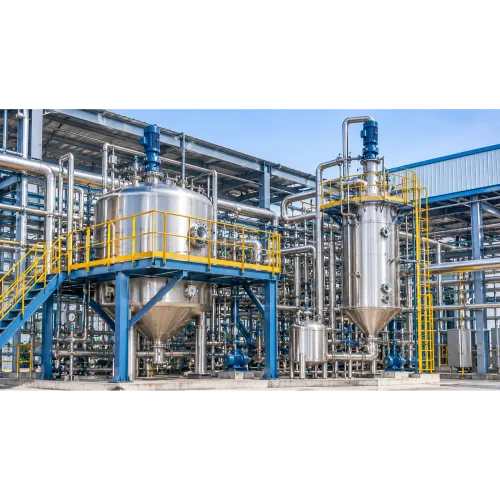
A jacketed chemical reactor is a vessel surrounded by an external chamber through which a heating or cooling medium circulates. The process material remains inside the reactor, while the utility medium flows through the jacket and transfers heat across the vessel wall.
Depending on the application, the jacket may circulate steam, hot water, thermal oil, chilled water, cooling water or another compatible heat-transfer fluid.
During an exothermic reaction, the jacket may remove heat generated by the reaction. During an endothermic reaction or a heating stage, it may supply the energy needed to reach and maintain the required temperature.
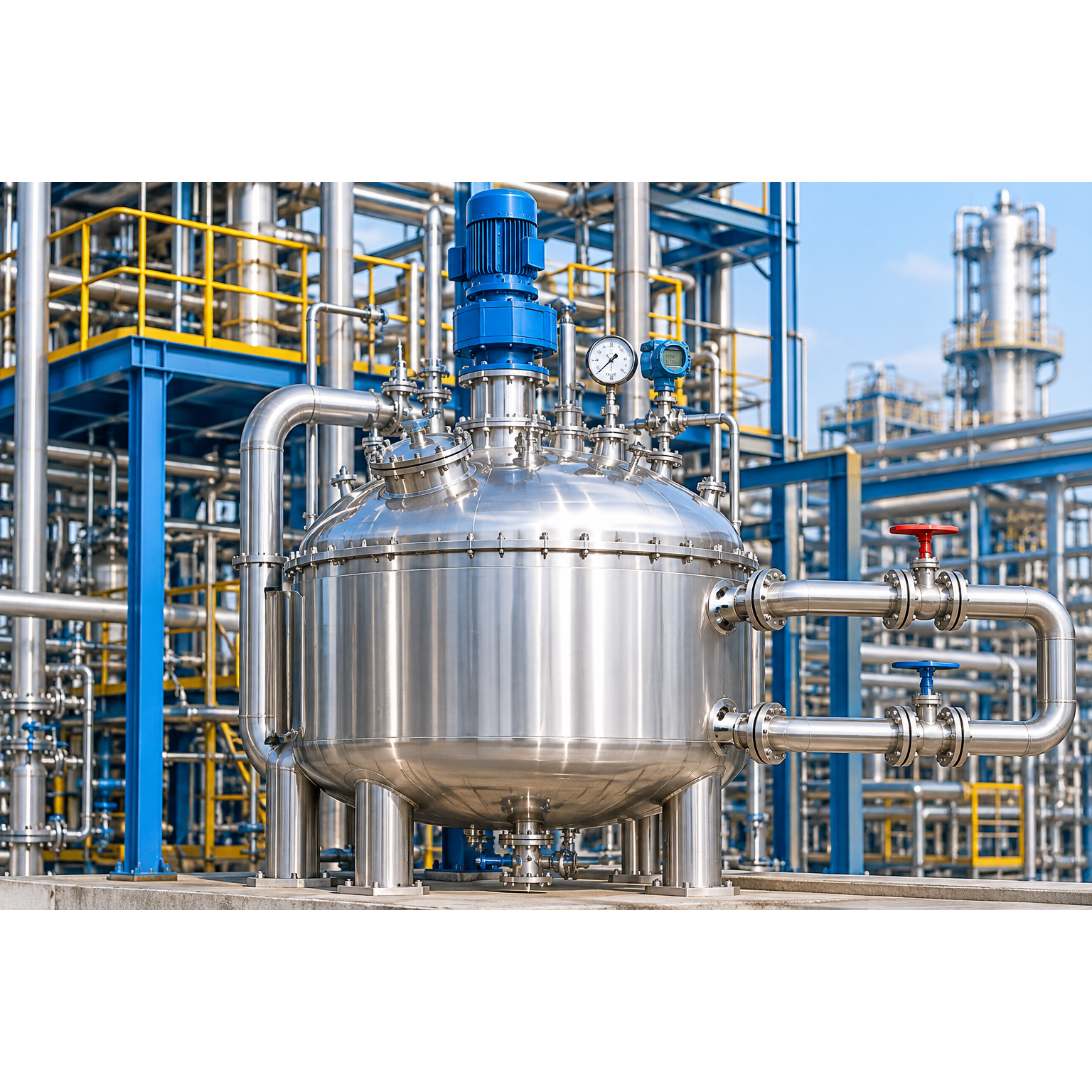
A typical jacketed reactor system may include:
Reactor vessel and jacket assembly.
Agitator, shaft and suitable impeller.
Heating or cooling utility connections.
Temperature sensors and control instruments.
Utility circulation or control valves.
Condenser, vent or vapour-handling equipment where required.
Pressure relief and other protective devices appropriate to the process.
The final configuration depends on reaction chemistry, operating pressure, temperature range, batch size and the required degree of automation.
2. Types of Reactor Jacket Configurations
Jacket design influences utility flow, heat-transfer performance, pressure drop and the uniformity of temperature around the vessel. The appropriate configuration depends on the vessel geometry, heat duty and properties of the heating or cooling medium.
Conventional jacket
A conventional jacket forms an outer chamber around part or all of the reactor vessel. The heating or cooling medium circulates through this space and transfers heat through the reactor wall.
This arrangement is relatively straightforward and may be suitable for applications with moderate heat-transfer requirements. However, utility distribution and flow conditions must be assessed to avoid poor circulation or uneven heat transfer.
Dimple jacket
A dimple jacket uses a formed outer sheet attached to the vessel wall at regular intervals, creating flow passages for the heat-transfer medium.
The configuration can support controlled utility distribution and may be suitable for reactors requiring efficient heating or cooling in a compact arrangement. Its performance depends on the dimple pattern, utility pressure, flow rate and fabrication design.
Half-pipe coil jacket
A half-pipe jacket uses formed pipe sections welded to the exterior of the vessel, creating defined flow channels around the shell.
It is often considered for applications requiring higher utility-side pressure capability or controlled flow through individual jacket circuits, subject to the engineered design. The arrangement can also allow separate utility zones where appropriate.
Multi-zone jacket
A multi-zone jacket divides the heat-transfer area into separate circuits. Different sections can receive utility flow independently or under coordinated control.
This arrangement may help manage temperature distribution in larger vessels or processes with changing heat loads. It adds piping, instrumentation and control complexity, so its benefits should be justified by the process requirements.
| Jacket configuration | Main design consideration | Typical selection factor |
|---|---|---|
| Conventional jacket | Utility circulation and distribution | Moderate heating or cooling duty |
| Dimple jacket | Flow passage geometry and pressure drop | Compact jacket arrangement and utility distribution |
| Half-pipe coil jacket | Circuit design, pressure and flow | Defined circulation paths and demanding utility conditions |
| Multi-zone jacket | Independent circuit control and temperature distribution | Larger vessels or variable heat loads |
No single jacket configuration is best for every reactor. The selection must consider the required heat duty, utility conditions, vessel dimensions, mechanical design and fabrication constraints.
3. Heat Transfer in a Jacketed Chemical Reactor
Heat transfer occurs across several stages: the utility transfers heat to or from the reactor wall, heat passes through the vessel material, and the process liquid absorbs or releases energy.
The overall heat-transfer performance depends on the available heat-transfer area, the temperature difference between the utility and process material, and the combined thermal resistance of the utility film, vessel wall and process-side film.
A simplified relationship is:
[
Q = U A \Delta T_{\mathrm{lm}}
]
Where:
(Q) = heat-transfer rate.
(U) = overall heat-transfer coefficient.
(A) = effective heat-transfer area.
(\Delta T_{\mathrm{lm}}) = logarithmic mean temperature difference.
The relationship provides a starting point for design, but actual performance also depends on changing batch temperature, utility flow, fouling, viscosity and reaction heat generation.
Key factors influencing heat transfer include:
Temperature difference: A larger driving temperature difference can increase heat transfer, subject to product stability and material limits.
Heat-transfer area: Vessel dimensions and the wetted jacket area determine the available area for heat exchange.
Utility flow rate: Adequate circulation supports utility-side heat transfer and helps maintain temperature distribution.
Process viscosity: Highly viscous liquids may develop weak natural mixing near the vessel wall unless agitation and heat-transfer arrangements are appropriately designed.
Fouling and deposits: Material deposited on either side of the heat-transfer surface can reduce performance.
Reaction heat: Exothermic reactions may generate heat faster than the jacket can remove it if the system is not adequately sized.
The required heating and cooling duties should be calculated for the actual operating sequence, including charging, heating, reaction hold, cooling and discharge.
4. Agitation and Temperature Uniformity
Agitation is essential in many jacketed reactor applications because it promotes mixing and helps transfer heat between the vessel wall and the process material.
Without adequate mixing, temperature gradients may develop. The material near the wall may become hotter or colder than the bulk liquid, potentially affecting reaction rate, product quality or fouling.
The agitator and impeller should be selected according to viscosity, vessel geometry, solids content, mixing objective and operating speed.
Common considerations include:
Low-viscosity liquids: Axial-flow or other suitable impellers may provide effective bulk circulation.
Viscous materials: Anchor or helical-ribbon arrangements may be considered where wall sweeping and bulk movement are important.
Suspended solids: The impeller must maintain suitable solids suspension without creating unacceptable shear or settling.
Gas-liquid reactions: Agitation must support the required gas dispersion and mass transfer.
Scale-up: Mixing performance must be assessed at the intended vessel size rather than inferred from rotational speed alone.
Baffles may be required to limit vortex formation and improve mixing in suitable reactor designs. Impeller clearance, shaft strength, mechanical seals and motor requirements must also be considered.
For highly viscous or heat-sensitive materials, the relationship between agitation and jacket performance is especially important because insufficient mixing can limit the effective heat-transfer rate.
5. Temperature Control and Instrumentation
A jacketed chemical reactor commonly uses a temperature sensor to measure the process temperature and a control system to regulate utility flow or temperature.
A basic control loop compares the measured process temperature with the setpoint and adjusts a control valve, utility circulation system or heating/cooling arrangement accordingly.
Depending on the reaction, the control strategy may use a programmed temperature ramp, a controlled heating stage, a reaction hold period and a defined cooling profile.
Important design considerations include:
Sensor placement: The sensor should provide a representative measurement of the process temperature.
Utility control: Valve sizing and utility flow range should support stable control at both low and high heat loads.
Temperature response: Vessel size, batch mass, viscosity and jacket volume influence how quickly the system responds.
Control stability: Poorly tuned control loops can cause temperature oscillations or overshoot.
Independent monitoring: Additional temperature measurement may be needed where temperature gradients or local hot spots are credible concerns.
Automation: Batch sequencing, alarms and interlocks can support repeatable operation when designed around the process hazard assessment.
For strongly exothermic reactions, controlling the jacket temperature alone may not be sufficient. The design should consider the rate of heat generation, maximum credible reaction temperature, cooling failure scenarios and the time available for intervention.
6. Heating and Cooling Utility Selection
The heating and cooling media must be selected according to the operating temperature range, heat duty, utility availability, material compatibility and process safety requirements.
| Utility medium | Potential application | Important consideration |
|---|---|---|
| Steam | Heating and temperature ramping | Condensation, steam pressure, condensate drainage and temperature limits |
| Hot water | Moderate-temperature heating | Available temperature difference and circulation rate |
| Thermal oil | Higher-temperature heating where appropriate | Fluid stability, fire risk, expansion and leak management |
| Cooling water | Routine heat removal | Seasonal temperature variation, fouling and available cooling capacity |
| Chilled water or glycol-based fluid | Lower-temperature cooling | Required supply temperature, flow rate and system capacity |
Utility selection must account for the temperature difference needed to achieve the required duty. A cooling medium that is only slightly colder than the process may not provide sufficient heat removal, particularly during an exothermic reaction.
The jacket, connections, valves and associated piping must also be designed for the applicable utility pressure and temperature. The reactor's process-side design conditions and the jacket's utility-side design conditions should be assessed separately.
7. Process Safety Considerations in Reactor Design
Reactor safety requires an understanding of both the chemical reaction and the mechanical equipment. A jacketed vessel does not automatically provide sufficient protection against overheating or pressure rise.
Important safety considerations include:
Reaction heat and runaway risk: Reaction calorimetry and suitable process studies can help establish heat-release rates, accumulation potential and cooling requirements for hazardous exothermic reactions.
Cooling failure: The design should evaluate what happens if cooling water, chilled water, power or circulation is lost. Protective actions may include feed isolation, emergency cooling or another validated response appropriate to the chemistry.
Pressure protection: Relief systems should be sized and selected based on credible overpressure scenarios, including reaction gas generation, vapour generation and utility-related hazards where relevant.
Temperature and pressure limits: Instruments, alarms, trips and interlocks should reflect the process hazard assessment and equipment design limits. Independent protection may be needed for critical scenarios.
Material compatibility: Vessel, jacket, gasket, seal and piping materials must be compatible with the process chemicals, utility media, pressure and temperature.
Agitator and mechanical integrity: Shaft, impeller, seals and drive systems must be suitable for the viscosity, solids content, pressure conditions and operating loads.
Safe venting and vapour handling: Volatile, flammable, toxic or corrosive vapours may require a properly designed condenser, scrubber, closed vent system or other suitable treatment arrangement.
For hazardous reactions, the design should be supported by a process hazard assessment and applicable mechanical, electrical and statutory requirements. Protective measures must be selected for the specific reaction rather than applied as a generic checklist.
8. Material of Construction and Mechanical Design
Material selection affects corrosion resistance, contamination risk, fabrication, maintenance and service life. The correct material depends on the process chemistry, concentration, operating temperature and cleaning requirements.
Stainless steel grades such as SS304 and SS316L may be considered for compatible services. More demanding applications may require duplex stainless steel, super duplex, titanium or another suitable material following corrosion and compatibility assessment.
Mechanical design should address:
Process-side and jacket-side design pressure and temperature.
Vessel thickness and applicable design code.
Jacket construction, weld details and inspection requirements.
Corrosion allowance where appropriate.
Agitator support, shaft loads and sealing arrangement.
Nozzle locations, drainage and cleaning access.
Thermal expansion and differential movement.
Pressure testing, inspection and documentation requirements.
Where the vessel handles hazardous or high-pressure reactions, mechanical integrity and process safety must be considered together from the early design stage.
9. Key Inputs for Jacketed Chemical Reactor Selection
Before selecting a reactor configuration, engineers should establish the process duty and operating envelope.
Important inputs include:
Batch volume or required production capacity.
Chemical composition and material compatibility.
Reaction type and whether it is exothermic or endothermic.
Normal, minimum and maximum operating temperatures.
Process-side and jacket-side operating pressures.
Heating and cooling duty, including peak reaction heat.
Liquid viscosity and its variation with temperature.
Solids content, gas generation and mixing requirements.
Required heating and cooling time.
Available utilities and their supply conditions.
Cleaning, maintenance and automation requirements.
Applicable design codes and safety requirements.
These inputs help determine the vessel size, jacket configuration, agitator design, utility connections and temperature-control strategy. For exothermic reactions, reaction calorimetry or other appropriate process-safety studies may be needed before finalising the design.
Jacketed Chemical Reactor Design from Centpro Engineering
Centpro Engineering designs and manufactures chemical process equipment for industrial applications, including jacketed reactors with configurations selected according to process requirements. Reactor design considerations include vessel capacity, material of construction, agitation, heating and cooling duty, operating pressure and temperature-control requirements.
The objective is to match the reactor's mechanical design and heat-transfer arrangement to the reaction conditions, mixing requirements and plant operating needs.
For a reactor design assessment, share the required working volume, chemical composition, operating temperature and pressure, reaction heat characteristics, viscosity and available heating or cooling utilities with Centpro Engineering.