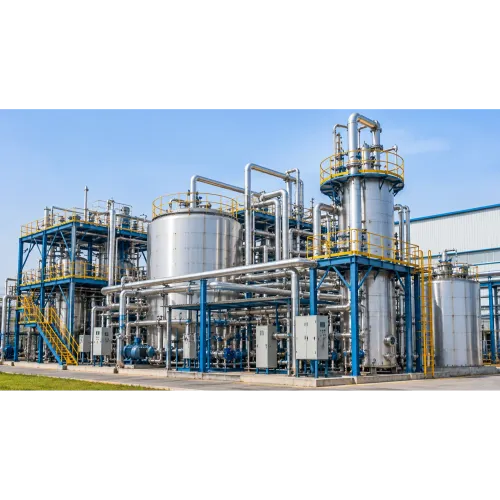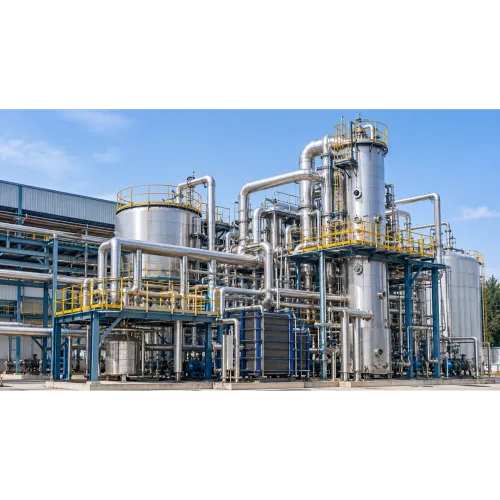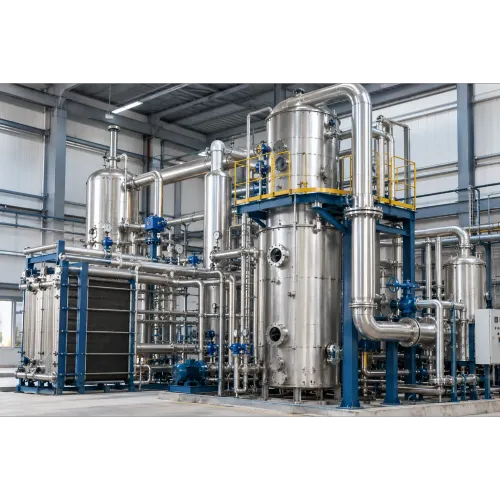

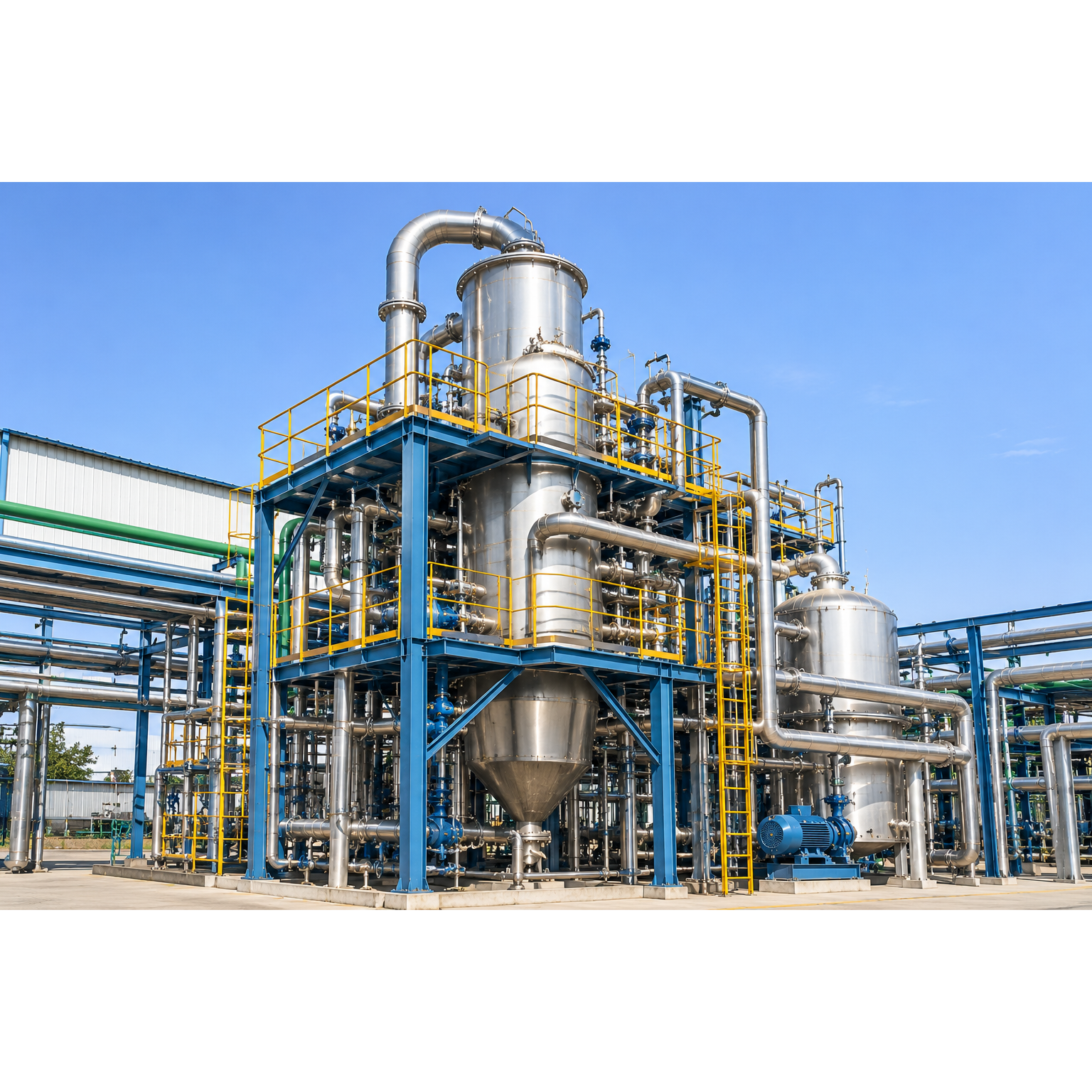
A forced circulation evaporator is an industrial evaporation system designed to concentrate liquids that may contain high dissolved solids, suspended particles or components that tend to form scale during heating. It is commonly considered for chemical process industries, pharmaceutical manufacturing, salt recovery and wastewater treatment applications where conventional evaporation arrangements may face operational challenges.
Unlike a natural circulation evaporator, a forced circulation evaporator uses a circulation pump to move the process liquid through a heat exchanger at a controlled, relatively high velocity. This helps maintain circulation through the heating section and reduces the tendency for deposits to accumulate on heat-transfer surfaces. The system is particularly useful when the liquid becomes more concentrated, viscous or prone to crystallisation as water evaporates.
The key design principle is to circulate the liquid rapidly through the heat exchanger and control where boiling occurs, helping manage scaling, fouling and slurry handling.
1. Working Principle of a Forced Circulation Evaporator
A forced circulation evaporator typically consists of a circulation pump, heat exchanger, vapour-liquid separation vessel and associated piping and controls.
The process liquid is pumped through the heat exchanger, where it receives heat from steam or another suitable heating medium. The liquid is generally maintained at sufficient pressure to limit boiling inside the heat exchanger tubes. The heated liquid then enters a lower-pressure separation vessel, where part of the liquid flashes into vapour.
The vapour is separated from the concentrated liquid and can be condensed or reused as part of an integrated evaporation system. The remaining liquid is recirculated through the heat exchanger, while a controlled portion is withdrawn as concentrate.
The exact arrangement depends on the feed properties, operating pressure, required concentration and downstream treatment requirements.
2. Why High-Velocity Circulation Matters
High-velocity circulation is one of the defining features of a forced circulation evaporator. The circulation pump moves liquid through the heat-transfer tubes at a velocity selected according to the process fluid and equipment design.
This circulation serves several purposes:
Improved heat transfer: Continuous movement supports heat transfer between the heating medium and the process liquid.
Reduced deposit formation: Higher liquid velocity can reduce the tendency of certain solids to settle and can help limit deposits on heat-transfer surfaces.
Better slurry movement: Suspended solids and crystallising material can remain in motion when the system is appropriately designed for the particle size, concentration and slurry properties.
More controlled operation: Stable circulation helps manage changes in concentration and temperature as the liquid becomes more concentrated.
High velocity does not eliminate scaling or fouling. Deposits can still form because of supersaturation, chemical reactions, local temperature conditions or unsuitable feed chemistry. Pump sizing, tube geometry, pressure drop, abrasion risk and cleaning requirements must therefore be evaluated together.
3. Heat Transfer and the Location of Boiling
In a forced circulation evaporator, heat is generally added in a heat exchanger while boiling is controlled to occur mainly in the separation vessel.
The circulating liquid passes through the heat exchanger under pressure. This pressure helps prevent extensive boiling within the tubes even as the liquid temperature rises. When the heated liquid enters the lower-pressure separator, a portion flashes into vapour because of the pressure reduction.
This arrangement can be beneficial for liquids that are sensitive to deposit formation or contain dissolved salts that may crystallise as concentration increases. Limiting boiling inside the heating tubes helps reduce the risk of localised concentration and crystal deposition under suitable operating conditions.
The actual boiling behaviour depends on operating pressure, temperature, liquid properties and the degree of concentration. System design must maintain appropriate pressure and temperature conditions throughout the circulation loop.
4. Handling Scaling, Crystallising Liquids and Slurries
Forced circulation evaporators are often selected for streams that become difficult to process as dissolved solids increase. These may include concentrated salt solutions, inorganic chemical liquors, industrial effluent concentrates and crystallising process streams.
As evaporation removes water, the concentration of dissolved material rises. Depending on the solubility of the compounds present, the liquid may approach saturation and begin forming crystals. Suspended solids may also enter with the feed or develop during processing.
A forced circulation arrangement can help transport these solids through the system, but successful slurry handling depends on more than circulation velocity alone.
Important design considerations include:
Solids concentration and particle size: These influence suspension, settling behaviour, pumping requirements and erosion risk.
Viscosity: Increasing viscosity can raise pressure drop and reduce circulation performance.
Solubility and supersaturation: These determine when crystals begin to form and where deposition is most likely.
Material of construction: Corrosion resistance must be assessed against the chemical composition, temperature and concentration of the process liquid.
Cleaning and maintenance: The design should account for potential deposits, inspection access and the selected cleaning method.
Where crystallisation is intended, the system may be integrated with a dedicated crystallizer and downstream solid-liquid separation equipment. The required arrangement depends on whether the objective is liquid concentration, controlled crystal production, salt recovery or further treatment of a ZLD stream.
5. Industrial Applications of Forced Circulation Evaporators
Forced circulation evaporators are used across industries where concentrated liquids, high dissolved solids or scaling tendencies influence equipment selection.
Chemical processing
Chemical manufacturing may generate concentrated inorganic or organic process liquors that require water removal before reuse, further processing or disposal. Forced circulation can be considered when the stream has scaling tendencies or becomes difficult to circulate at higher concentrations.
Zero Liquid Discharge (ZLD) systems
In industrial wastewater treatment, forced circulation evaporators can concentrate suitable RO reject or other pretreated effluent streams before crystallisation or further solids handling. Feed chemistry, organic content, scaling potential and condensate quality must be evaluated before selecting the process configuration.
Salt recovery and crystallisation
When a concentrated solution approaches saturation, forced circulation evaporation may be integrated with crystallisation equipment to recover salts. The crystallizer configuration and operating conditions must be matched to the salt composition, solubility behaviour and desired crystal properties.
Pharmaceutical and specialty chemical manufacturing
Certain process liquors and concentrated waste streams in pharmaceutical and specialty chemical plants may require evaporation under carefully controlled conditions. Suitability depends on the chemical properties of the stream, contamination controls, material compatibility and required product or waste-treatment standards.
Mineral and inorganic process streams
Selected mineral-processing liquors and inorganic solutions may require concentration before recovery or downstream processing. Abrasion, solids loading, corrosion and scaling potential are important factors when evaluating a forced circulation design.
6. Forced Circulation Evaporator vs. Falling Film Evaporator
The two configurations serve different process requirements. Selection should be based on feed characteristics rather than equipment type alone.
| Design consideration | Forced circulation evaporator | Falling film evaporator |
|---|---|---|
| Liquid movement | Pump-driven circulation through the heat exchanger | Liquid flows as a film over heat-transfer surfaces |
| Typical process fit | Concentrated, scaling-prone or slurry-containing streams when appropriately designed | Compatible, relatively low-viscosity liquids with good film distribution |
| Boiling arrangement | Generally controlled mainly in a separator vessel | Evaporation commonly occurs within the falling film, depending on design |
| Solids handling | Can accommodate selected suspended solids and crystallising liquids | More sensitive to solids deposition, poor wetting and distribution problems |
| Circulation power | Requires significant pumping duty | Usually does not require the same high-rate recirculation duty |
| Key selection concern | Pumping energy, pressure drop, erosion and deposit control | Film wetting, residence time, fouling and liquid distribution |
A forced circulation evaporator is not automatically the better option for every high-TDS stream. Feed viscosity, fouling behaviour, energy consumption, required concentration and capital cost should be compared during process design.
7. Integration with MEE, Crystallizers and ZLD Systems
A forced circulation evaporator can operate as a standalone concentration unit or as part of a larger thermal process system.
In a multiple-effect evaporator (MEE), vapour generated in one effect can provide heating for another effect, reducing the fresh steam requirement compared with a single-effect arrangement under suitable conditions. A forced circulation configuration may be used for streams that are less suitable for other evaporator types.
In a mechanical vapour recompression (MVR) system, suitable secondary vapour is mechanically compressed and reused as a heating medium. Whether MVR is appropriate depends on the required temperature lift, vapour characteristics, feed chemistry, electrical tariff and overall heat balance.
For ZLD applications, the concentrated liquid may proceed to a crystallizer or another suitable downstream treatment stage. Where solid salts are produced, equipment such as a centrifuge or filter may be required for solid-liquid separation. Recovered condensate should be checked for dissolved or volatile contaminants before reuse.
The complete process sequence must be established from the feed analysis, target concentration, salt composition and intended final output. Not every forced circulation evaporator requires a crystallizer, and not every ZLD system uses the same configuration.
8. Key Factors in Forced Circulation Evaporator Selection
A reliable design starts with an understanding of the process liquid and the required operating range.
Before selecting equipment, engineers should evaluate:
Feed flow rate and operating variability.
Total dissolved solids (TDS), suspended solids and chemical composition.
Viscosity and density across the concentration range.
Scaling, fouling, foaming and crystallisation tendencies.
Required evaporation duty and final concentrate concentration.
Available steam, electricity and cooling utilities.
Material of construction and corrosion requirements.
Circulation pump duty, pressure drop and erosion potential.
Condensate quality and potential for reuse.
Cleaning strategy, maintenance access and downstream solids handling.
A representative feed sample and reliable process data help establish whether forced circulation is suitable and whether it should be combined with another evaporation or crystallisation technology.
Forced Circulation Evaporator Solutions from Centpro Engineering
Centpro Engineering evaluates industrial evaporation requirements based on feed characteristics, concentration targets, heat-transfer conditions and downstream process needs. For scaling-prone liquids, concentrated effluent and selected crystallising streams, forced circulation evaporation can be assessed alongside other suitable evaporator configurations and thermal ZLD systems.
The objective is to develop a process arrangement that addresses heat transfer, circulation, deposit control, energy consumption and maintainability as part of the overall plant design.
For a process-specific evaluation, share your feed flow rate, TDS, chemical composition, operating conditions and required final concentration with Centpro Engineering.