
Industrial evaporators are widely used in chemical processing, pharmaceutical manufacturing, wastewater treatment and Zero Liquid Discharge (ZLD) systems to concentrate solutions and recover water. However, as water evaporates, dissolved salts, suspended particles and other compounds become increasingly concentrated, creating conditions that can lead to scaling and fouling.
Deposits on heat-transfer surfaces reduce thermal efficiency, restrict flow and increase cleaning frequency. In demanding applications, uncontrolled fouling can result in higher energy consumption, reduced evaporation capacity and unplanned plant shutdowns.
Reliable evaporator performance depends on controlling deposit formation through appropriate flow velocity, temperature management, circulation design, feed conditioning and a well-planned cleaning strategy.
1. Understanding Scaling and Fouling: Why Deposits Form
Scaling occurs when dissolved compounds precipitate and accumulate on equipment surfaces. Fouling is a broader term that includes deposits formed by suspended solids, organic matter, chemical reactions and other contaminants.
Common causes include:
Salt precipitation: Calcium salts, sulphates, carbonates and other compounds may exceed their solubility limits as the solution becomes concentrated.
High local temperatures: Heat-transfer surfaces can create conditions that promote precipitation or accelerate deposit formation.
Suspended solids: Fine particles may settle or accumulate on surfaces, restricting heat transfer and flow.
Organic deposits: Certain organic compounds can adhere to surfaces or form deposits under operating conditions.
Poor circulation: Low-flow regions can encourage particle settling, concentration gradients and localised fouling.
Feed variability: Changes in pH, salt composition, solids content and concentration can alter the tendency to scale.
The type of deposit matters because different fouling mechanisms require different preventive measures and cleaning methods. Understanding the feed chemistry is therefore an essential starting point for evaporator design.
2. Flow Velocity: Maintain Effective Heat-Transfer Conditions
Liquid velocity influences heat transfer, particle suspension and the accumulation of deposits inside an evaporator.
In forced-circulation systems, adequate circulation helps maintain uniform operating conditions and reduces the likelihood of solids settling in susceptible areas. However, increasing velocity without considering the equipment design can increase pumping power, erosion and mechanical stress.
Key design considerations include:
Circulation velocity through heat-transfer tubes
Slurry viscosity and suspended-solids concentration
Particle settling and abrasion potential
Pressure drop and pumping requirements
Tube geometry and flow distribution
The objective is to establish a suitable operating range for the actual fluid and equipment configuration. There is no single optimum velocity for every evaporator; the correct value depends on the slurry properties, tube dimensions and process conditions.
3. Temperature Profile: Control Localised Precipitation
Temperature affects both heat-transfer performance and the solubility of dissolved compounds. In some applications, higher temperatures can increase the tendency of salts to precipitate, while in others, temperature changes can alter solubility in different ways.
Localised overheating, excessive wall temperatures and uneven temperature distribution may create conditions that accelerate deposits on heat-transfer surfaces.
Important considerations include:
Heating-medium temperature and temperature difference
Boiling point elevation of the concentrated solution
Heat-transfer surface temperature
Feed concentration and salt solubility
Temperature distribution across the equipment
Product sensitivity to thermal degradation
Selecting an appropriate operating temperature and heat-transfer arrangement helps balance evaporation duty with fouling risk. Multiple-effect evaporators (MEE) and mechanical vapour recompression systems (MVR/MVRE) should be evaluated against the feed's thermal and chemical characteristics rather than energy efficiency alone.
4. Circulation Design: Match the Evaporator to the Feed
Different evaporator configurations manage liquid flow and deposit formation in different ways.
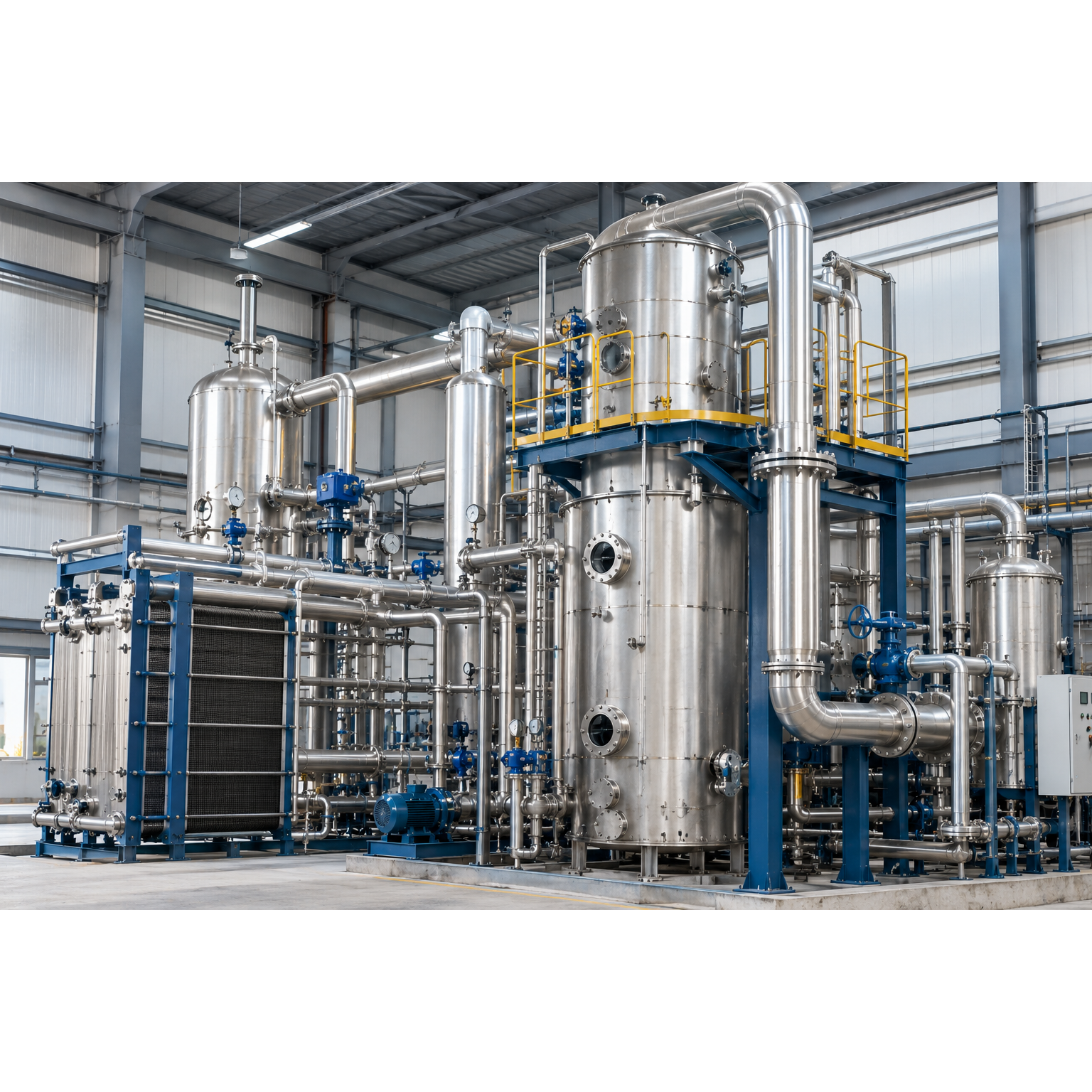
Forced-circulation evaporators move the process liquid through a heat exchanger using a circulation pump. They are often considered for concentrated, scaling-prone or solids-bearing streams because circulation can be designed to maintain suitable flow conditions and keep precipitation under control.
Falling-film evaporators distribute liquid as a thin film over heat-transfer surfaces. They can provide efficient heat transfer and relatively short residence times, but require suitable wetting, distribution and feed characteristics.
Rising-film evaporators use vapour generation to drive liquid upward through heating tubes. Their suitability depends on boiling behaviour, viscosity and other process-specific factors.
Selection considerations include:
Feed viscosity and concentration
Scaling and fouling tendency
Suspended solids and crystal formation
Required evaporation capacity
Heat-transfer performance and residence time
Cleaning access and maintenance requirements
For high-TDS industrial effluent, selecting an evaporator based on process chemistry and circulation behaviour can be more important than choosing equipment solely by nominal capacity.
5. Feed Conditioning: Reduce the Risk Before Evaporation
Fouling control begins upstream of the evaporator. Pretreatment can reduce the substances responsible for deposits and improve operating stability.
Depending on the wastewater composition, suitable measures may include:
Screening and filtration to remove suspended particles
pH adjustment to manage precipitation risks
Softening or selective removal of scale-forming ions
Chemical treatment where technically justified
Equalisation to manage variations in feed composition
Controlled concentration and feed-flow management
Pretreatment should be selected through water analysis and process evaluation. Removing one scaling compound may affect the behaviour of other dissolved constituents, so treatment decisions should consider the complete chemistry of the feed.
6. Cleaning Strategy: Restore Heat-Transfer Performance
Even a well-designed evaporator may accumulate deposits over time. A suitable cleaning strategy helps restore performance and prevent excessive downtime.
Cleaning methods may include chemical cleaning, water flushing, mechanical cleaning or a combination of approaches, depending on the deposit type and equipment design.
Important considerations include:
Identification of deposit composition
Selection of compatible cleaning chemicals
Cleaning frequency based on operating trends
Equipment materials and gasket compatibility
Safe isolation, drainage and rinsing
Verification of restored heat-transfer performance
Chemical cleaning must be selected carefully to avoid corrosion, damage to equipment materials or unwanted reactions. Cleaning procedures should follow the equipment manufacturer's recommendations and the plant's safety requirements.
7. Monitoring Performance: Identify Fouling Before Capacity Falls
Monitoring operating parameters helps identify developing deposits before they cause major production interruptions.
Useful indicators include:
Increasing temperature difference required to maintain evaporation duty
Changes in heat-transfer performance
Rising circulation-pump pressure drop or power consumption
Declining evaporation capacity at comparable operating conditions
Increasing differential pressure across susceptible flow paths
Changes in product concentration and operating stability
These trends should be interpreted alongside feed flow, composition, steam conditions, vacuum and other operating variables. A change in performance does not automatically indicate fouling, but consistent deviations can signal the need for investigation.
Integrating Fouling Control into Evaporator Design
Scaling and fouling cannot always be eliminated, particularly when treating concentrated industrial brines. However, their impact can be managed through the combined selection of evaporator configuration, operating conditions, pretreatment, instrumentation and cleaning provisions.
Centpro Engineering evaluates evaporator applications by considering feed characteristics, concentration targets, heat-transfer requirements, circulation, material compatibility and downstream process conditions. This approach helps establish a suitable configuration for industrial concentration and thermal ZLD applications.
Planning an evaporator system for scaling-prone or high-TDS effluent? Share your feed composition, flow rate, TDS, major dissolved salts, operating temperature, target concentration and existing fouling or cleaning challenges. These details help identify the process factors that should be evaluated during evaporator selection and design.