

Centpro Engineering designs forced circulation evaporators in Pune for scaling-prone, high-solids and crystallizing streams in chemical and effluent treatment plants.
Forced Circulation Evaporator Manufacturer in Pune
A forced circulation (FC) evaporator uses a pump to move process liquid through a heat exchanger at high velocity before it enters a separate vapour separator. This arrangement helps reduce boiling and salt deposition on heat-transfer surfaces. Centpro Engineering, based in Hadapsar, Pune, designs forced circulation evaporators for industrial streams that tend to scale, foul or form crystals during concentration.
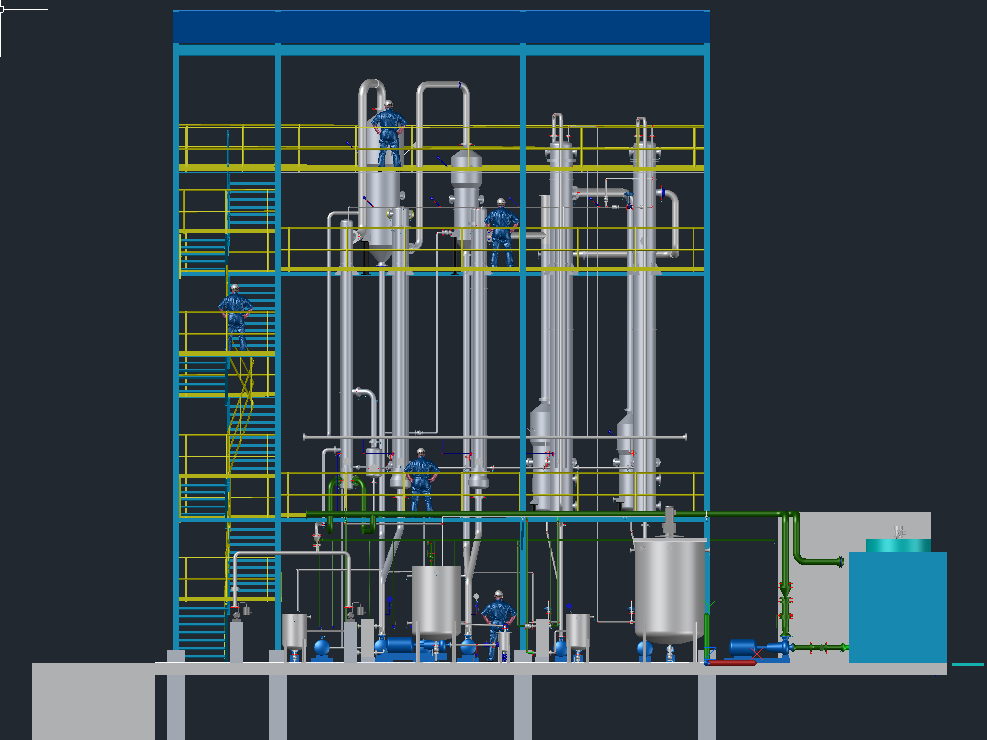
How a Forced Circulation Evaporator Works
A circulation pump moves the liquid through the heat exchanger at a controlled velocity. Pressure is maintained to limit boiling inside the tubes. The heated liquid then enters a flash vessel or vapour separator, where a pressure drop allows part of the liquid to evaporate.
Moving most of the boiling away from the heat-transfer surface helps reduce localised salt deposition. High circulation velocity can also help keep suspended solids moving through the system. However, performance depends on feed chemistry, operating conditions and the type of solids present.
Designed for Scaling-Prone and Crystallizing Streams
Forced circulation evaporators are commonly considered for duties where conventional falling film systems may face operating difficulties.
Typical applications include:
High-TDS effluent concentration: Concentrating dissolved salts before downstream treatment or residue handling.
Crystallizing services: Managing streams in which solids precipitate during evaporation.
Final-effect evaporation: Handling difficult, concentrated liquor in a multiple effect evaporator (MEE) train.
Chemical process concentration: Treating suitable brines, mother liquors and process solutions containing suspended solids.
Key Design Considerations
Correct selection requires more than knowing the feed flow rate. Centpro evaluates:
Circulation rate and pump selection: To maintain suitable tube velocity without excessive pumping demand.
Temperature rise per pass: To manage local concentration and crystallization risks.
Pressure and flash vessel design: To control boiling location and vapour separation.
Heat-transfer materials: Selected according to chloride content, acidity, alkalinity and corrosion risks.
Solids characteristics: Particle size, crystal formation, viscosity and settling tendency affect circulation and operation.
Cleaning requirements: Scaling chemistry determines the likely cleaning method, frequency and maintenance access.
Benefits and Limitations
A forced circulation evaporator can reduce tube-surface deposition, maintain movement of suspended solids and support concentration of difficult process streams. It can also be integrated with MEE or mechanical vapour recompression (MVR/MVRE) systems where the process and operating economics justify it.
The trade-off is higher circulation-pump power and generally greater liquid hold-up than in many falling film designs. It may therefore be less suitable for heat-sensitive products that require very short residence times. Forced circulation reduces certain scaling risks; it does not eliminate scaling or remove the need for cleaning.
Industrial Applications
Thermal ZLD plants and high-TDS effluent treatment
RO reject and salt-laden brine concentration
Chemical and pharmaceutical mother liquor concentration
Suitable sulphate-, chloride- and caustic-containing process streams
Industrial liquids containing suspended solids
Concentration duties upstream of crystallization or solids recovery
Why Choose Centpro Engineering?
Centpro evaluates feed chemistry, scaling behaviour, final concentration, utilities and maintenance needs before selecting an evaporator configuration. Forced circulation can be integrated with upstream and downstream process equipment to suit the overall treatment scheme. Centpro provides process engineering, equipment manufacturing, supply, installation and commissioning support.
Frequently Asked Questions
1. How is a forced circulation evaporator different from a falling film evaporator?
A forced circulation evaporator pumps liquid through a heat exchanger and flashes it in a separate vessel. A falling film evaporator distributes liquid as a thin film inside tubes. Forced circulation is often considered for scaling or solids-bearing feeds, while falling film is commonly used for cleaner feeds requiring short residence time.
2. Does forced circulation eliminate scaling?
No. It can reduce deposition under suitable operating conditions, but scale formation and periodic cleaning may still occur.
3. Is a forced circulation evaporator suitable for high-TDS effluent?
It can be suitable, depending on salt solubility, crystallization tendency, viscosity, corrosion and the required final concentration.
4. Can it operate with MVR?
Yes. Forced circulation can be combined with MVR in suitable applications. Both compressor power and circulation-pump power should be considered when evaluating operating costs.
5. What information is required for selection?
Feed flow rate, composition, solids content, target concentration, scaling history, temperature limits, available utilities and material compatibility are important starting points.
Enquire About a Forced Circulation Evaporator
Share your feed composition, flow rate, target concentration and scaling history to discuss a suitable process configuration.
Centpro Engineering Pvt. Ltd.
Email: sales@centpro.com
Phone: +91 80-4275-4893
WhatsApp: +91 70660 14007
Location: Hadapsar, Pune, Maharashtra, India
