

A falling film evaporator concentrates liquids by distributing them as a thin film inside heated vertical tubes. This arrangement supports efficient heat transfer and short residence time, making it suitable for many heat-sensitive and low-viscosity products. Centpro Engineering, based in Hadapsar, Pune, designs falling film evaporators for chemical, pharmaceutical and food-processing applications, as well as for integration into multiple effect evaporator (MEE) and mechanical vapour recompression (MVR/MVRE) systems.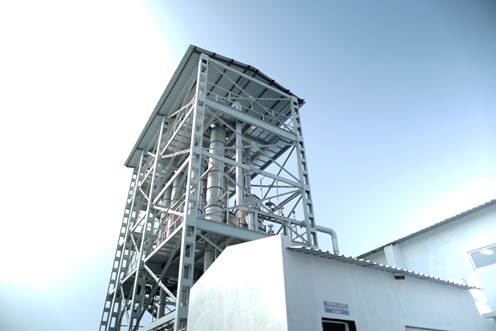
How a Falling Film Evaporator Works
Feed enters at the top of a vertical tube bundle, where a liquid distributor spreads it across the tube surfaces. Gravity draws the liquid downward as a thin film while heat supplied through the tube walls causes part of the liquid to evaporate. The resulting vapour and concentrated liquid are separated in a vapour-liquid separator.
Because the liquid flows as a film rather than remaining in a deep pool, the system can achieve short residence time and operate effectively with relatively small temperature differences. Actual performance depends on feed properties, film distribution, operating pressure and available heat-transfer area.
Thin-Film Evaporation for Heat-Sensitive Products
Falling film evaporators are often considered when product quality and temperature exposure are important.
Key design factors include:
Liquid distribution: Uniform wetting helps prevent dry patches, local overheating and deposits on tube surfaces.
Viscosity: Increasing viscosity can affect film flow and heat transfer as concentration rises.
Residence time: Short exposure can help limit thermal degradation in suitable products.
Foaming and entrainment: Vapour separation and demisting help limit liquid carryover.
Recirculation: May be required to maintain adequate tube wetting, particularly at reduced feed rates.
Cleaning requirements: The design should account for product residues, fouling behaviour and cleaning access.
When Is Falling Film the Right Choice?
Falling film evaporators are well suited to many relatively clean liquids with low scaling and fouling tendencies. However, feeds containing substantial suspended solids, crystallizing salts or highly viscous concentrates can create distribution problems, deposits or tube blockages.
For these duties, a forced circulation evaporator may be more appropriate. In some treatment schemes, falling film evaporation is used for initial concentration before the stream moves to forced circulation or crystallization for further concentration.
Key Benefits
Short residence time for suitable heat-sensitive products
Efficient heat transfer with appropriate temperature differences
Compatibility with MEE and MVR/MVRE configurations
Relatively low liquid hold-up
Compact vertical arrangement
Potential for hygienic design where food or pharmaceutical requirements apply
Industrial Applications
Pharmaceutical and herbal extract concentration
Dairy, juice and food ingredient processing
Chemical solutions with manageable fouling tendencies
Initial concentration stages in selected effluent treatment schemes
Suitable solvent-water mixtures requiring controlled temperature exposure
Acid or caustic solutions, subject to material compatibility
Integration with Other Process Equipment
Falling film evaporators can form part of a wider process line involving feed preheaters, condensers, vapour separation and condensate handling. In MEE systems, vapour from one effect can provide heating for another. With MVR, recompressed vapour can supply heat where operating conditions and feed properties permit.
Centpro evaluates the complete process requirement rather than selecting the evaporator in isolation.
Why Choose Centpro Engineering?
Centpro considers feed characteristics, temperature limits, viscosity, fouling risk, utilities and downstream processing before recommending an evaporator configuration. Process engineering, equipment manufacturing, supply, installation and commissioning are coordinated to support integration with the wider plant.
Frequently Asked Questions
1. What liquids suit a falling film evaporator?
Many low-viscosity, low-fouling liquids, including suitable food, pharmaceutical and chemical solutions.
2. Can a falling film evaporator handle suspended solids?
Feeds with significant suspended solids can obstruct tubes or disturb film distribution. Feed conditioning or an alternative configuration may be necessary.
3. Why is liquid distribution important?
Uneven distribution can leave parts of the tube surface insufficiently wetted, increasing the risk of local overheating and fouling.
4. Can falling film evaporators operate with MVR?
Yes. They can be integrated with MVR systems when the feed properties, temperature difference and overall process conditions are suitable.
5. Can falling film evaporation be used for high-salt effluent?
It may be suitable for an initial concentration stage when scaling is manageable. More concentrated or crystallizing streams may require forced circulation or crystallization equipment.
Enquire About a Falling Film Evaporator
Share your product composition, feed rate, viscosity, temperature limits and required final concentration to discuss a suitable configuration.
Centpro Engineering Pvt. Ltd.
Email: sales@centpro.com
Phone: +91 80-4275-4893
WhatsApp: +91 70660 14007
Location: Hadapsar, Pune, Maharashtra, India
Website: https://www.centproengineering.com/
