
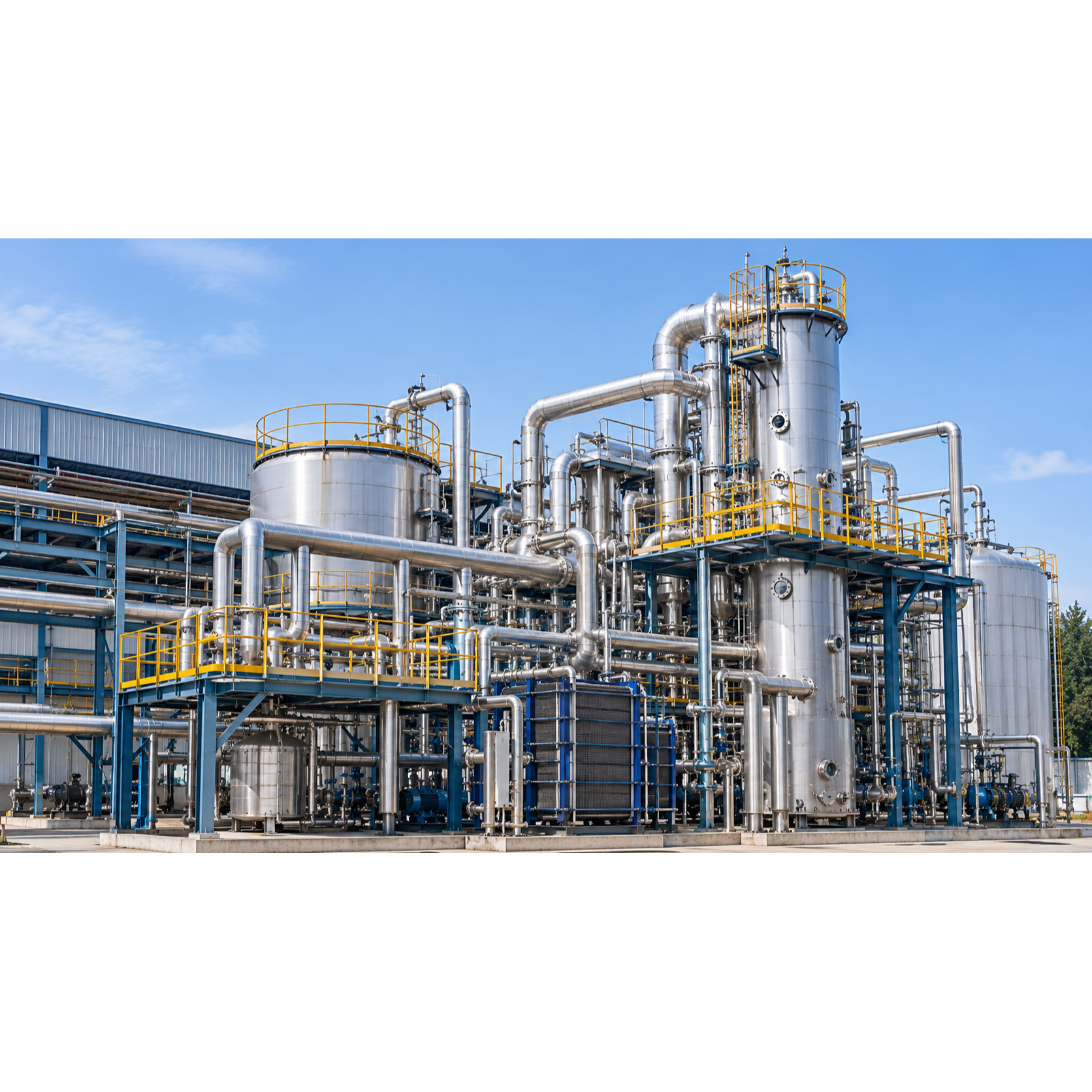
Zero Liquid Discharge (ZLD) systems help industries recover water and manage concentrated wastewater, but their operating costs can be significant due to steam consumption, electricity demand, scaling, maintenance and residue handling.
Heat integration is one of the key engineering approaches to improving ZLD operating efficiency. By recovering and reusing available thermal energy across the treatment process, industries can reduce fresh steam demand, improve overall energy utilisation and support more economical long-term operation.
However, reducing energy costs involves more than selecting an efficient evaporator. Steam economy, vapour reuse, condensate recovery, MEE/MVR integration and operating conditions must be evaluated together to optimise the complete ZLD system.
1. Steam Economy: Maximise the Use of Available Thermal Energy
Steam economy indicates how effectively an evaporator uses steam to evaporate water. In a multiple-effect evaporator (MEE), vapour generated in one effect supplies heat to the next effect, allowing the same thermal energy to be used across multiple stages.
A well-designed MEE can reduce fresh steam consumption compared with a single-effect system, although actual performance depends on operating conditions and process constraints.
Key considerations include:
Number of effects and operating pressure levels
Feed temperature and feed-distribution arrangement
Boiling point elevation of the process liquid
Heat-transfer performance and fouling tendency
Condensate and vapour losses
Required evaporation capacity and product concentration
Adding more effects does not automatically deliver the best economics. The additional heat-transfer area, temperature differences, operating complexity and feed characteristics must be assessed against the expected reduction in steam consumption.
2. Vapour Reuse: Recover Heat Instead of Rejecting It
Vapour produced during evaporation contains useful thermal energy. Where suitable temperature and pressure conditions exist, this vapour can be reused to heat another process stream or supply energy to a downstream evaporator effect.
Effective vapour utilisation reduces the amount of fresh thermal energy required by the system.
Potential opportunities include:
Using secondary vapour as the heating medium for subsequent evaporator effects
Recovering heat from suitable vapour streams through heat exchangers
Preheating incoming wastewater using available process heat
Evaluating vapour reuse in compatible upstream or downstream operations
Reducing unnecessary heat losses from condensers and associated piping
Vapour reuse must account for pressure, temperature, non-condensable gases, contamination risks and the heat demand of the receiving process. The objective is to recover useful energy without compromising product quality or process stability.
3. Condensate Recovery: Recover Water and Residual Heat
Steam condensate and clean process condensates can represent valuable opportunities for water and energy recovery.
When steam transfers its heat to an evaporator, the resulting condensate may retain useful sensible heat. Depending on its quality and the plant's steam system, it may be returned to the boiler feedwater system or used for another suitable purpose.
Important design considerations include:
Condensate temperature and pressure
Contamination by process-side leaks or volatile compounds
Condensate collection and return arrangements
Flash-steam recovery opportunities
Boiler feedwater quality and treatment requirements
Potential use of clean process condensate for suitable applications
Condensate recovery can reduce fresh-water demand, boiler makeup requirements and the energy required to heat replacement water. Process condensate should be evaluated separately from steam condensate because its quality and suitability for reuse depend on the wastewater composition and evaporation process.
4. MEE and MVR Integration: Match the Technology to the Duty
Multiple-effect evaporation (MEE) and mechanical vapour recompression (MVR/MVRE) are two important approaches to improving evaporation energy efficiency.
MEE: Reuses vapour heat across multiple effects operating at different pressure levels. It is often considered where suitable steam is available and the process can support multiple-effect operation.
MVR/MVRE: Mechanically compresses suitable secondary vapour to increase its temperature and pressure, allowing it to be reused as a heating medium. This can significantly reduce fresh steam demand but requires electrical power for the compressor.
Selection should consider:
Available steam and electricity tariffs
Required evaporation capacity
Feed composition and boiling point elevation
Vapour compression ratio and temperature lift
Scaling and fouling potential
Required turndown and operating flexibility
Capital cost, maintenance and lifecycle economics
A hybrid MEE–MVR configuration may be worth evaluating where the process duty, utility availability and operating profile support it. The preferred arrangement should be established through heat-and-mass-balance calculations and techno-economic analysis rather than assuming one technology is always more economical.
5. Feed Preheating and Thermal Recovery: Reduce the Heating Load
Incoming wastewater often requires heating before evaporation. Recovering heat from suitable hot process streams can reduce the additional energy needed to bring the feed to operating temperature.
Potential heat-recovery sources include:
Hot condensate streams
Suitable evaporator outlet streams
Process streams requiring cooling
Recoverable heat from compatible vapour or exhaust streams
The heat exchanger design must account for temperature approach, fluid properties, corrosion, fouling and the possibility of cross-contamination.
Preheating the feed can reduce the sensible-heating requirement of the evaporator, although the actual savings depend on the available heat source, feed temperature and system configuration.
6. Thermal Optimisation: Balance Energy Savings with Reliability
Operating an evaporator at the lowest possible temperature or highest possible concentration does not automatically minimise total ZLD costs.
Higher concentration can reduce downstream liquid volume but may increase viscosity, boiling point elevation, scaling risk and cleaning requirements. Similarly, lowering operating temperature may affect heat-transfer performance or require additional vacuum-system duty.
Key optimisation factors include:
Evaporation temperature and pressure
Heat-transfer area and temperature difference
Concentration targets and boiling point elevation
Circulation rate and fouling control
Vacuum-system and cooling-system performance
Operating hours, load variation and cleaning downtime
An effective design balances energy consumption with plant reliability, maintenance requirements and downstream crystallization or solids-handling costs.
7. Integrating Heat Recovery Across the Complete ZLD System
The greatest opportunities may emerge when heat recovery is evaluated across the complete treatment train rather than within the evaporator alone.
A typical system may include pretreatment, RO, brine concentration, evaporation, crystallization and solid-liquid separation. The optimal heat-integration strategy depends on the energy requirements and operating conditions of each stage.
A system-level assessment should examine:
Overall steam and electricity consumption
Vapour generation and reuse opportunities
Condensate recovery and quality
Feed preheating potential
MEE/MVR configuration and operating flexibility
Heat losses, fouling and cleaning frequency
Lifecycle operating costs and maintenance requirements
A properly integrated system can reduce avoidable energy losses and improve utility utilisation. Actual savings should be established using site-specific process data, utility tariffs and a validated energy balance.
Reducing ZLD Operating Costs with Centpro Engineering
Centpro Engineering approaches thermal ZLD as an integrated process-engineering challenge. Evaporator selection, steam economy, vapour reuse, condensate recovery and crystallizer integration should be evaluated together to establish a technically suitable and economically practical system.
The objective is to optimise the complete process around wastewater characteristics, available utilities, water-recovery targets and operating requirements—not simply to minimise the energy consumption of one equipment item.
Evaluating energy optimisation for your existing or proposed ZLD plant? Share your wastewater flow rate, TDS, required evaporation capacity, existing MEE/MVR configuration, steam pressure and consumption, electricity tariff and operating hours. These details can support a preliminary assessment of heat-recovery and thermal-integration opportunities.