

Centpro Engineering designs and manufactures MEE systems in Pune for industrial effluent concentration, process liquid recovery and steam-efficient evaporation.
Multiple Effect Evaporator Systems for Industrial Applications
Centpro Engineering designs and manufactures Multiple Effect Evaporator (MEE) systems in Pune, Maharashtra, for concentrating industrial effluent and process liquids. Our customized evaporation solutions help chemical, pharmaceutical, textile and food processing industries reduce wastewater volume, recover condensate where suitable, and optimize steam consumption.
Industrial MEE Design Focused on Steam Economy
A Multiple Effect Evaporator uses vapour generated in one evaporation stage to heat the next stage, which operates at a lower pressure and temperature. This reuse of thermal energy improves steam economy compared with single-effect evaporation.
Centpro engineers evaluate feed flow rate, total dissolved solids (TDS), boiling point elevation, viscosity, scaling tendency and available utilities to determine the appropriate number of effects and system configuration. Depending on process requirements, the design may incorporate falling-film, rising-film or forced-circulation evaporators.
Key Benefits:
Improved steam economy through vapour reuse
Reduced industrial wastewater volume
Customized evaporation capacity and configuration
Condensate recovery potential, subject to quality
Integration with ATFD and crystallizers for suitable ZLD applications
Material selection based on process chemistry
Process-specific engineering and commissioning support
Applications of Multiple Effect Evaporators
Centpro MEE systems can be designed for:
Chemical and specialty chemical effluent concentration
Pharmaceutical process liquids and suitable wastewater streams
Textile and dyeing industry effluent treatment
RO reject concentration and thermal ZLD systems
Mother liquor and salt solution concentration
Food processing liquids, brines and process washes
Customized Evaporator Selection
The right MEE configuration depends on feed characteristics and operating economics. High boiling point elevation, increasing viscosity, foaming and salt deposition can affect evaporation performance. Centpro considers these factors alongside steam availability, cooling water requirements, material compatibility and cleaning needs to develop an appropriate process solution.
Where required, MEE systems can be integrated with forced-circulation evaporators, condensers, crystallizers and Agitated Thin Film Dryers (ATFD) to support downstream concentration and solids
handling.
Why Choose Centpro Engineering?
Centpro combines process engineering, equipment manufacturing and turnkey project execution to develop evaporation solutions around actual industrial requirements. Our approach focuses on suitable equipment selection, thermal performance, operating costs and integration with the wider treatment process.
Frequently Asked Questions
1. What is a Multiple Effect Evaporator used for?
An MEE concentrates process liquids and industrial effluent by reusing vapour energy across multiple evaporation stages.
2. How is steam consumption optimized?
Steam economy is improved by reusing vapour between effects. Actual performance depends on feed properties and operating conditions.
3. Can an MEE be integrated with a ZLD plant?
Yes. An MEE can form part of a thermal ZLD system with suitable downstream crystallization or drying equipment.
4. What information is required for MEE design?
Feed flow rate, TDS, composition, pH, target concentration, operating temperature and available utilities are important initial inputs.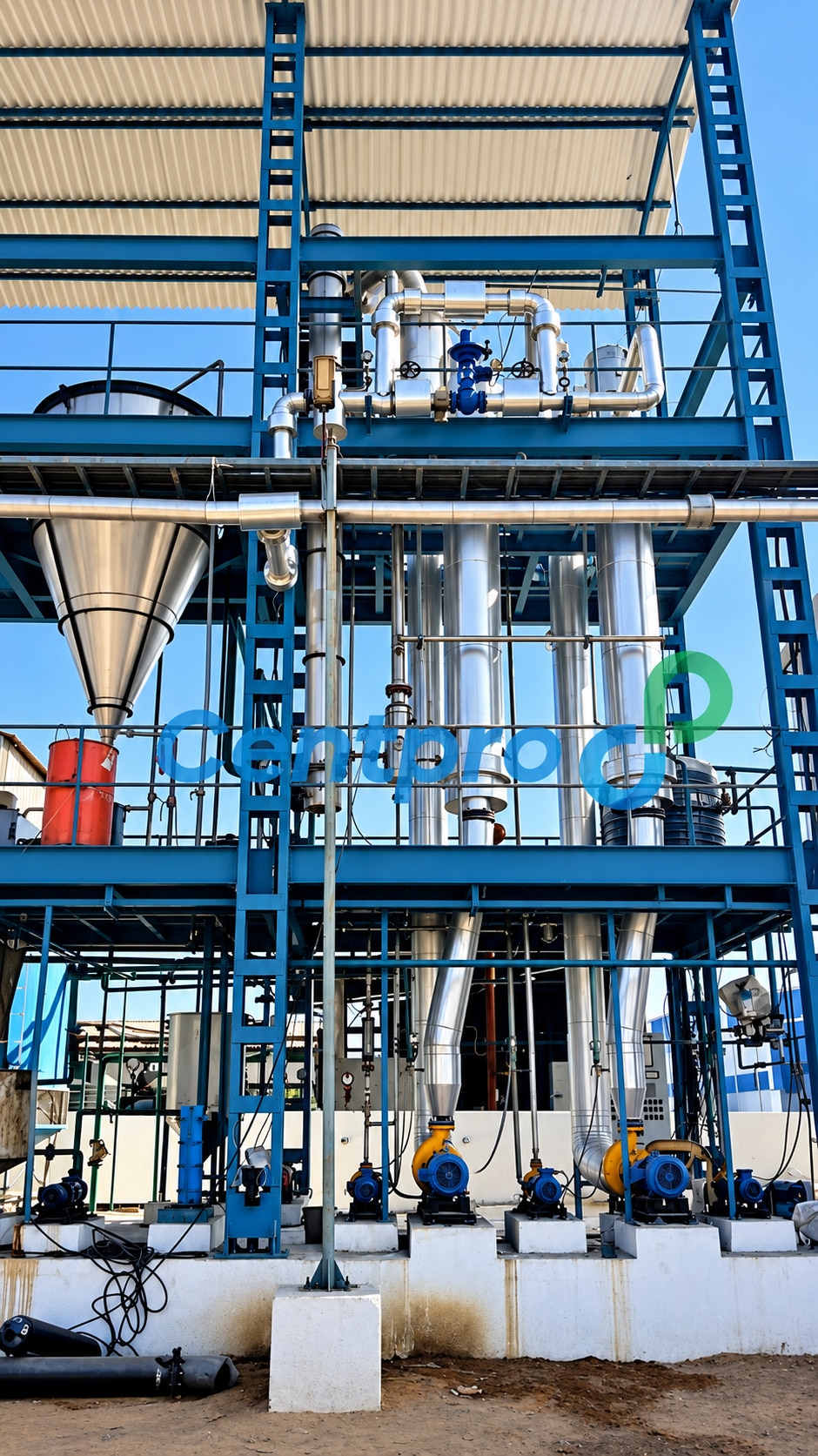
Enquire Now
Contact Centpro Engineering for customized MEE design and industrial evaporation solutions.
Email: sales@centpro.com
Phone: +91 80-4275-4893
WhatsApp: +91 70660 14007
Location: Hadapsar, Pune, Maharashtra, India
