
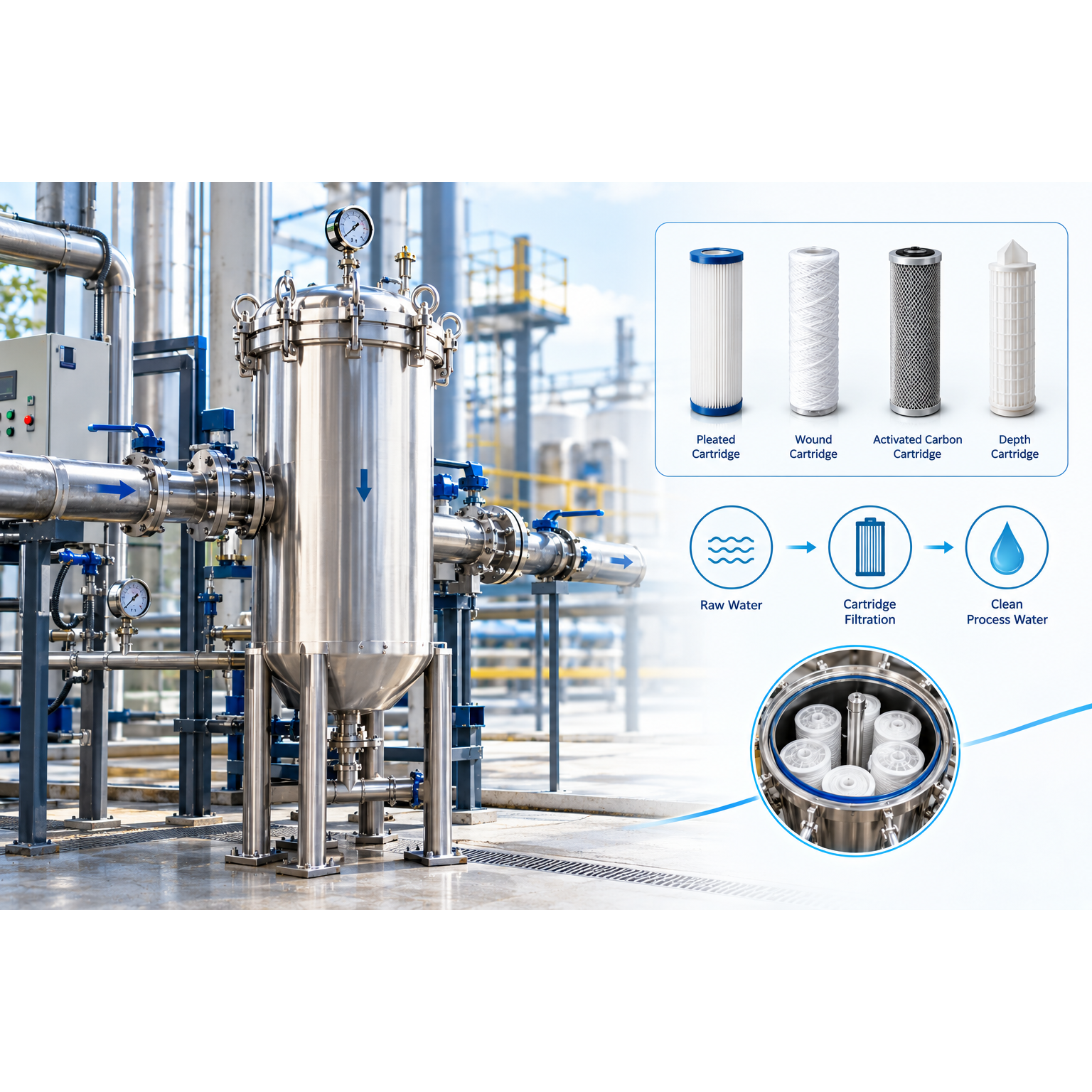
Cartridge filtration plays an important role in industrial water treatment by removing suspended particles before water enters sensitive process equipment. In applications such as RO systems, chemical processing, pharmaceutical utilities and process-water supply, the correct filtration stage helps protect membranes, reduce downstream contamination and maintain consistent operating performance.
However, selecting a cartridge filter involves more than choosing a micron rating. Filtration efficiency depends on particle characteristics, flow rate, filter media, pressure drop, housing material and the required downstream water quality.
1. Micron Rating: Define the Required Particle Removal
The micron rating indicates the particle size a filter is designed to retain. The appropriate rating depends on the contaminants present and the protection required by downstream equipment.
Coarser filtration can remove larger suspended particles, while finer filtration is used when smaller particles must be retained. For example, cartridge filters installed before RO membranes are selected according to feed-water quality, pretreatment performance and membrane protection requirements.
It is also important to distinguish between nominal and absolute ratings. A nominal rating represents a stated level of particle removal under specified conditions, whereas an absolute rating generally indicates a more stringent retention specification. Actual efficiency should be confirmed from the manufacturer's test data.
2. Flow Rate: Match Capacity to Process Demand
The cartridge filter must handle the required operating flow without excessive pressure drop or premature blockage.
Design considerations include:
Normal and peak flow rates
Number and length of cartridges
Effective filtration area
Fluid viscosity and temperature
Contaminant loading and replacement frequency
Undersized filtration can increase differential pressure and operating interruptions. Proper sizing helps maintain stable flow and practical cartridge service life.
3. Filter Media: Select for Fluid Compatibility
Filter media determines particle retention, chemical compatibility and operating suitability.
Common options include polypropylene (PP), pleated polymer media and other application-specific materials. Polypropylene cartridges are widely used for particulate filtration in compatible water and process streams.
Selection must consider fluid chemistry, pH, temperature, suspended solids and any regulatory or product-contact requirements. For chemical and pharmaceutical applications, material compatibility and the required level of cleanliness are particularly important.
4. Pressure Drop: Monitor Filtration Performance
Pressure drop is the difference between the inlet and outlet pressures of the filter. It generally increases as retained particles accumulate within the cartridge.
Excessive pressure drop can reduce available downstream pressure and increase operating costs. Differential-pressure monitoring helps determine when cartridges require replacement, subject to the filter manufacturer's specified limits.
Initial pressure drop, allowable terminal pressure drop, fluid viscosity and contaminant loading should all be considered during design.
5. Housing Material: Match the Process Environment
The filter housing must withstand operating pressure, temperature and the chemical characteristics of the fluid.
Depending on the application, housing options may include stainless steel, duplex stainless steel, super duplex stainless steel or other suitable materials. Material selection should account for corrosion resistance, chloride concentration, cleaning requirements and mechanical design conditions.
For industrial water and chemical process applications, selecting the housing material based only on pressure rating may overlook important corrosion risks.
6. Cartridge Configuration: Design for Maintainability
Cartridge length, diameter, end connection and the number of cartridges determine the available filtration area and housing capacity.
A multi-cartridge housing can accommodate higher flow rates by distributing the load across multiple elements. Longer cartridges may provide greater filtration area per element, depending on the design.
The configuration should also allow practical cartridge replacement, sealing integrity, safe maintenance and minimal process interruption.
Selecting the Right Cartridge Filtration Stage
An effective filtration system is designed around the complete process requirement. A cartridge filter installed before RO membranes may have different requirements from one used for final process-water polishing or chemical-stream filtration.
Centpro Engineering offers industrial cartridge filtration solutions with application-specific consideration of flow capacity, filtration rating, cartridge configuration and housing material. Depending on the application, housing options can include SS, MS, duplex and super duplex materials, with suitable filter elements selected for the process conditions.
Planning an industrial cartridge filtration system? Share your required flow rate, fluid composition, suspended-solids characteristics, target micron rating, operating pressure and temperature, and downstream equipment requirements. Centpro Engineering can evaluate a suitable cartridge filter configuration for your process.