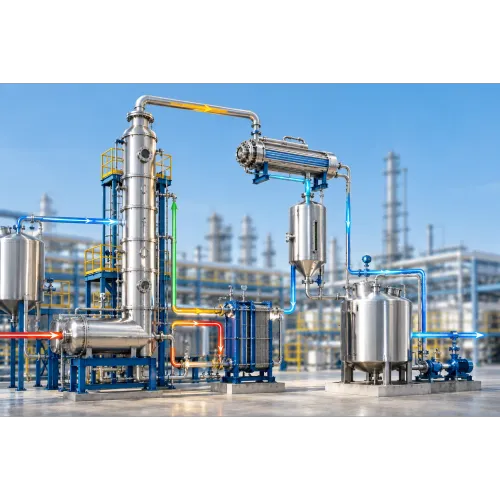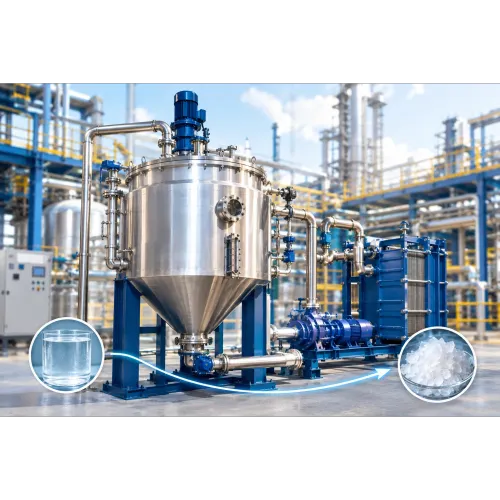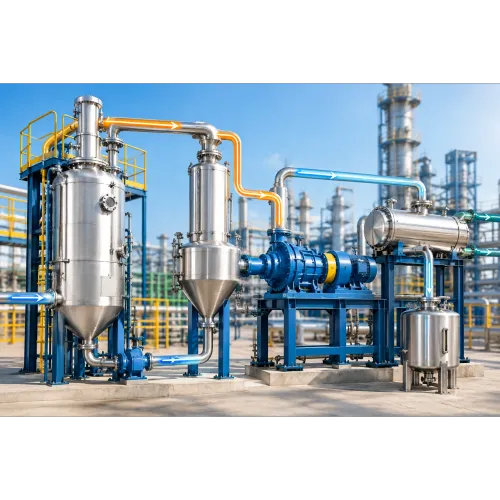

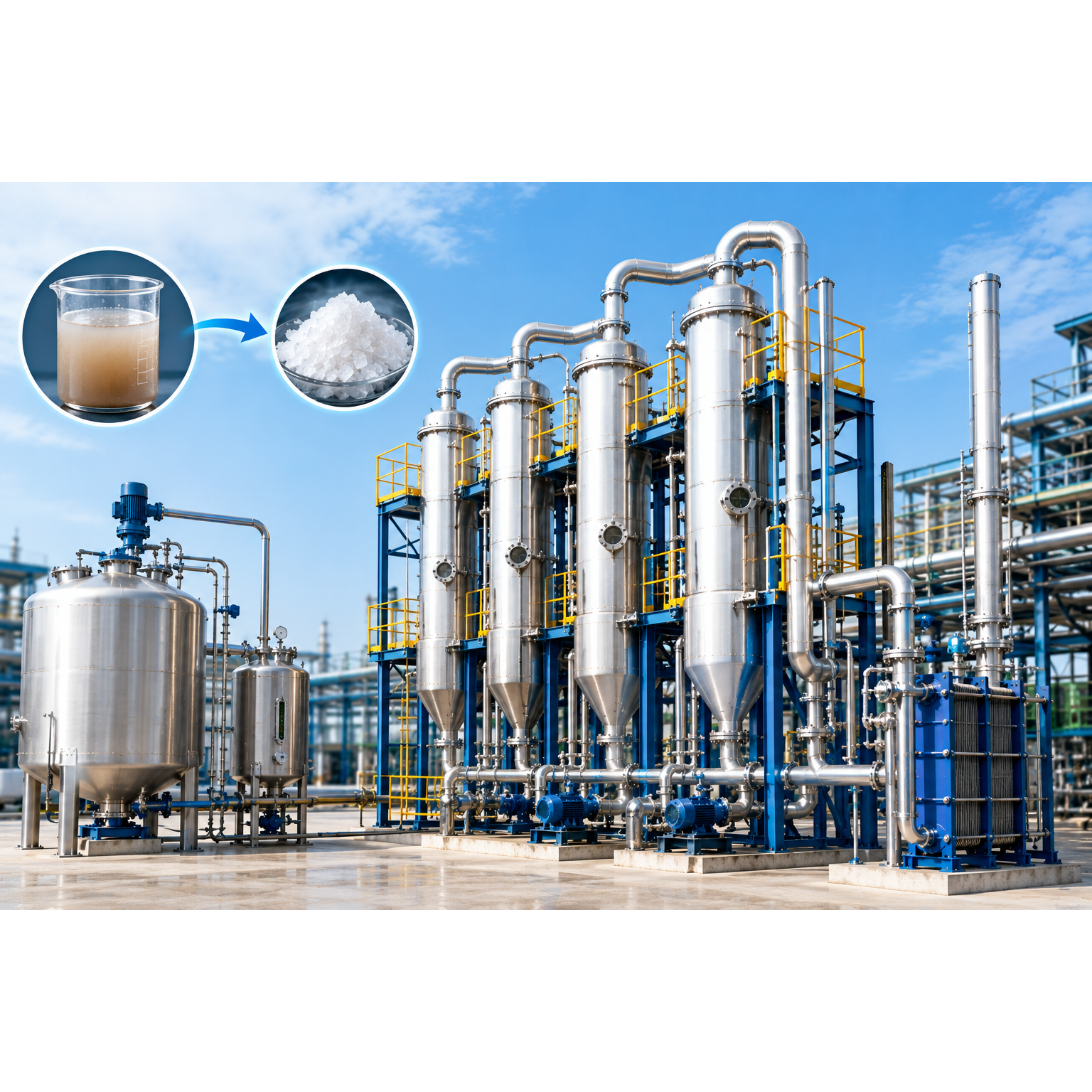
High-TDS effluent becomes increasingly difficult to treat as dissolved salts and contaminants become concentrated. Conventional wastewater treatment can remove suspended solids and some dissolved pollutants, but once the stream reaches very high TDS levels, thermal evaporation becomes an important step toward Zero Liquid Discharge (ZLD).
Industrial evaporators are designed to progressively remove water while concentrating the dissolved solids, preparing the stream for crystallization or final solids handling.
Concentration Starts With Controlled Water Removal
In a typical ZLD system, treated effluent may first pass through RO, where a significant portion of water is recovered and the reject stream contains a higher concentration of dissolved salts.
The concentrated reject can then enter an MEE, MVR/MVRE or other suitable evaporative system. The evaporator removes water as vapour while retaining most of the dissolved solids in the liquid phase.
As evaporation continues:
Feed → Water Removal → TDS Concentration → Higher Viscosity → Further Concentration → Crystallization / Solids Handling
The objective is not simply to “boil wastewater.” The evaporation system must control concentration, heat transfer, circulation and operating conditions throughout the process.
TDS Buildup Changes the Evaporation Process
As water is removed, TDS increases continuously. A feed that initially has moderate dissolved solids can become a highly concentrated brine after several stages of evaporation.
At higher concentrations, several process conditions change:
- Viscosity can increase
- Heat-transfer coefficients can decrease
- Salt solubility limits can be approached
- Boiling-point elevation becomes significant
- Scaling tendency can increase
- Vapour generation and circulation characteristics change
This is why an evaporator cannot be selected only on the basis of feed flow rate. Feed chemistry and the expected concentration profile are equally important.
Boiling-Point Rise Affects Heat Transfer
One of the important challenges in high-TDS evaporation is boiling-point elevation (BPE).
Pure water boils at a lower temperature than a concentrated salt solution at the same pressure. As dissolved solids increase, the boiling temperature of the solution rises.
This reduces the effective temperature difference available for heat transfer.
For example, if the heating medium is maintained at a fixed temperature, increasing BPE means less usable temperature driving force between the heating surface and the boiling liquid.
Therefore, evaporator design must account for:
- Feed concentration
- Final concentration
- Operating pressure
- Boiling-point elevation
- Heating-medium temperature
- Heat-transfer area
- Circulation rate
Scaling Becomes a Major Design Challenge
At high TDS concentrations, salts can reach their solubility limits and begin depositing on heat-transfer surfaces.
This scaling creates an insulating layer, reducing heat transfer and increasing energy consumption. Severe scaling can also restrict circulation and increase cleaning frequency.
Different salts behave differently. Chlorides, sulphates, carbonates, silica and other dissolved components can influence scaling behavior in different ways.
Consequently, evaporation systems for difficult effluent require process-specific evaluation rather than a standard equipment configuration.
Why Evaporation Becomes Essential Before ZLD
The purpose of evaporation in ZLD is to remove the remaining water and convert a large-volume liquid stream into a much smaller volume of concentrated brine.
Depending on the process, MEE or MVR/MVRE can be used for efficient concentration, followed by ATFD, crystallization or another solids-handling system for the final stage.
The complete configuration depends on the wastewater chemistry, recovery target, energy availability and required final solids characteristics.
At CentPro Engineering, evaporator design considers the complete concentration path—from feed characteristics and TDS buildup to BPE, scaling tendency, heat integration and final solids handling.
Planning a high-TDS evaporation or ZLD system? Share your effluent flow rate, TDS, major salts, inlet temperature, RO reject quantity and required recovery. We can evaluate the appropriate MEE, MVR/MVRE, ATFD or integrated ZLD configuration for your process.