
In an industrial evaporation system, a significant amount of energy is required to remove water from a process stream. Conventional evaporators often use fresh steam as the heating medium, while the generated vapour leaves the system after transferring its heat.
Mechanical Vapour Recompression (MVR) takes a different approach: instead of treating the generated vapour as waste, it compresses and reuses it as the heating source.
At CentPro Engineering, MVR and MVRE systems are engineered around the actual feed characteristics, evaporation duty, vapour conditions and required concentration.
How Does MVR Work?
During evaporation, water is converted into vapour. In a conventional system, this vapour may be condensed and its latent heat is not fully reused within the same effect.
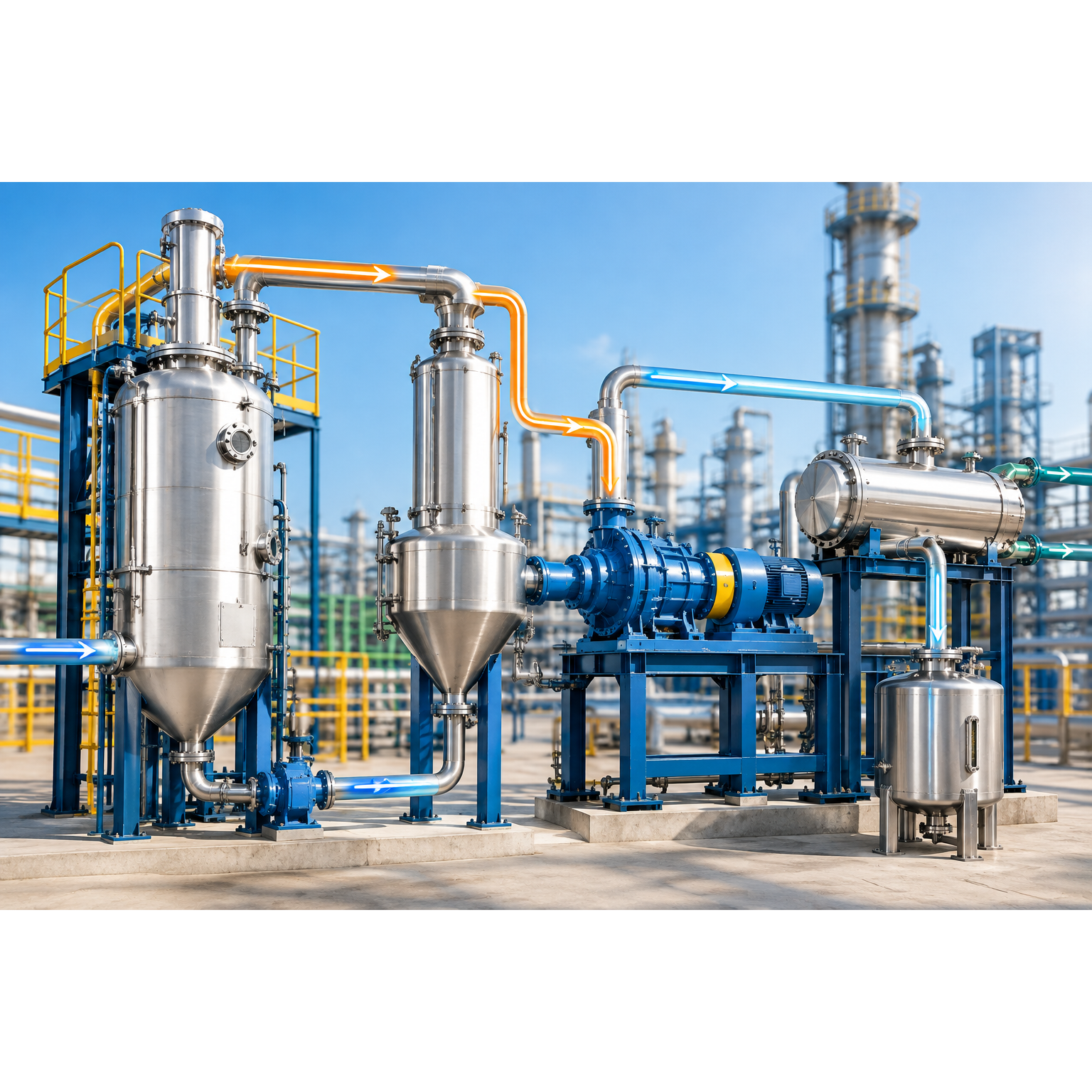
In an MVR system, the generated vapour is collected and sent to a mechanical compressor or vapour recompressor. Compression increases the vapour's pressure and saturation temperature.
The recompressed vapour can then be used as the heating medium for the evaporator.
In simple terms:
Evaporation → Vapour Generation → Vapour Compression → Temperature Increase → Vapour Reused for Heating
This creates a continuous cycle where the latent heat of the vapour is repeatedly reused.
Why Does MVR Reduce Steam Consumption?
The major advantage of MVR is heat recovery within the evaporation process.
Instead of continuously supplying large quantities of fresh steam, the system uses electrical energy to recompress the generated vapour and raise its temperature sufficiently to drive further evaporation.
As a result, fresh steam consumption can be significantly reduced compared with conventional single-effect evaporation, although the actual saving depends on the process conditions, temperature lift, evaporation load and system configuration.
The trade-off is that the MVR compressor requires electrical power.
MVR vs. Conventional Evaporation
In conventional evaporation, fresh steam provides the primary heating energy and the generated vapour is progressively condensed or reused through multiple effects.
In an MVR system, the vapour generated from the process is mechanically recompressed and returned as a heating medium.
This makes MVR particularly attractive where the plant has a high and continuous evaporation load and where reducing steam consumption is a priority.
Where Is MVR Used?
MVR can be applied to a wide range of industrial concentration processes, including:
ZLD and wastewater concentration
Chemical and specialty chemical effluent
Pharmaceutical process streams
High-TDS wastewater
Solvent and process-liquid concentration
Food and dairy applications
Industrial brine concentration
The suitability of MVR depends on feed composition, boiling point elevation, viscosity, scaling tendency, required concentration and vapour characteristics.
MVRE: Combining Evaporation With Vapour Recompression
MVRE (Mechanical Vapour Recompression Evaporation) integrates the evaporation process with mechanical vapour recompression.
The evaporator removes water from the feed while the generated vapour is recompressed and reused to provide the required heating duty. This arrangement can be engineered as part of a larger concentration or ZLD system, depending on the process requirement.
Proper integration of MVRE with upstream and downstream equipment is important to achieve the intended energy performance.
Process Design Comes First
MVR is not simply about installing a compressor on an evaporator. The complete process must be evaluated.
Feed flow rate, feed concentration, boiling temperature, boiling point elevation, vapour pressure, heat-transfer characteristics, scaling potential and final concentration all influence the design.
CentPro Engineering evaluates these parameters along with heat integration and utility requirements to develop an evaporation system suited to the application.
Looking to Reduce Steam Consumption?
Share your feed flow rate, TDS/concentration, inlet temperature, required evaporation capacity and final concentration with CentPro Engineering. Our process engineering team can evaluate the suitability of MVR/MVRE and develop an energy-efficient evaporation solution for your plant.
Enquire with CentPro Engineering for customised MVR, MVRE and industrial evaporation solutions.