
Recovering Energy from Vapor Instead of Wasting It
Energy consumption is one of the most important factors influencing the operating cost of industrial evaporation systems. In conventional evaporators, a significant portion of the generated vapor is condensed and its latent heat is lost. Mechanical Vapor Recompression (MVR) changes this approach by recovering the vapor and converting it into a reusable source of thermal energy.
CentPro Engineering Pvt. Ltd. designs and manufactures MVR Evaporator Systems for Zero Liquid Discharge (ZLD), chemical processing, pharmaceutical manufacturing, high-TDS wastewater treatment, and other energy-intensive applications. By combining vapor recompression with efficient evaporation technology, our systems can significantly reduce dependence on fresh steam and improve the overall energy efficiency of the plant.
How MVR Technology Works
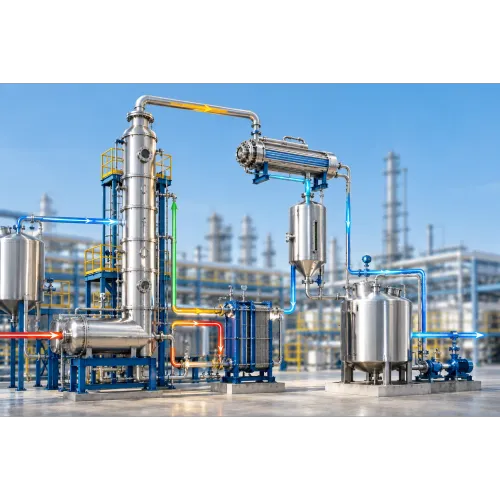
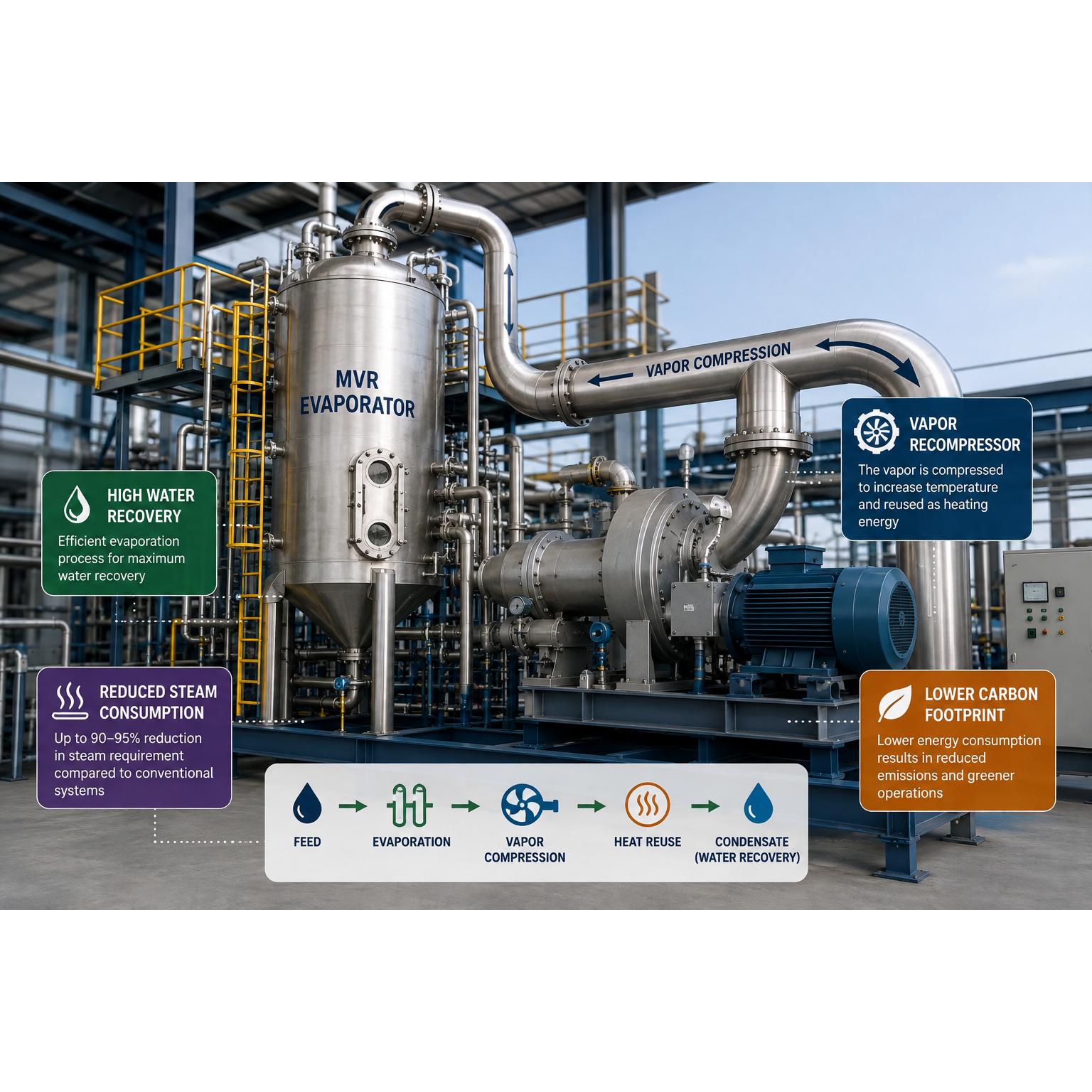
During evaporation, water vapor is generated as the liquid is concentrated. Instead of rejecting this vapor, an MVR system captures it and sends it through a mechanical compressor.
The compressor increases the vapor pressure and temperature. This upgraded vapor is then returned to the evaporator as the heating medium, allowing the same latent heat to be reused continuously within the process.
Evaporation → Vapor Generation → Vapor Compression → Temperature Increase → Heat Reuse → Continuous Evaporation
This closed-loop energy recovery mechanism is what makes MVR technology particularly attractive for applications where steam consumption and operating costs are major concerns.
Why MVR Is Important for ZLD Plants
Zero Liquid Discharge systems often involve intensive thermal evaporation because concentrated wastewater must be processed after membrane treatment. Conventional thermal systems can require substantial quantities of steam, particularly when treating large wastewater volumes.
MVR technology can reduce this steam requirement by internally recycling the evaporation vapor. This makes MVR an important technology for industries looking to achieve high water recovery while controlling thermal energy consumption.
When integrated with RO, MEE, crystallizers, condensate recovery, and automated process control, MVR can form an efficient thermal core of a modern ZLD plant.
CentPro's MVR Engineering Approach
MVR systems cannot be designed as a standard, one-size-fits-all solution. Feed characteristics, evaporation capacity, boiling point elevation, scaling tendency, viscosity, concentration ratio, operating temperature, and available electrical power all influence the final system design.
CentPro evaluates these process parameters before developing the evaporation configuration.
Our engineering considerations include:
Feed flow rate and composition
TDS and concentration profile
Boiling point elevation
Scaling and fouling tendency
Required evaporation capacity
Final concentrate characteristics
Steam availability
Electrical power availability
Heat transfer requirements
Condensate quality and recovery
Material compatibility
Automation and control requirements
This process-oriented approach helps ensure that the MVR system delivers the required evaporation performance while maintaining stable and economical operation.
Key Features of CentPro MVR Evaporator Systems
High thermal energy efficiency
Significant reduction in fresh steam requirement
Mechanical vapor recompression technology
Continuous vapor energy recovery
Customized evaporation capacity
High water recovery potential
Automated PLC and SCADA-based control
Advanced instrumentation and process monitoring
Integration with RO, MEE, and crystallization systems
Corrosion-resistant material options
Suitable for high-TDS and difficult industrial streams
Compact and efficient process configuration
Designed for continuous industrial operation
Reduced dependence on external thermal energy
Energy Efficiency and Operating Cost Reduction
The primary advantage of MVR is the reuse of evaporation vapor. Rather than continuously supplying large quantities of fresh steam, electrical energy is used to compress the generated vapor and increase its temperature to the required heating level.
This can substantially reduce fresh steam consumption, particularly in processes with suitable evaporation characteristics and adequate electrical power availability.
However, the most economical technology depends on the specific process. CentPro evaluates steam cost, electricity cost, feed characteristics, evaporation load, operating hours, and utility availability before recommending MVR, MEE, or a hybrid configuration.
MVR Applications
CentPro MVR evaporator systems can be engineered for diverse industrial applications, including:
Zero Liquid Discharge Plants
Concentration of RO reject and high-TDS streams prior to crystallization and salt recovery.
Chemical Industry
Concentration of chemical solutions, mother liquors, and process wastewater.
Pharmaceutical Industry
Concentration and recovery of process streams where controlled evaporation and water recovery are required.
Specialty Chemicals
Treatment of complex and high-value process streams requiring efficient thermal separation.
Textile Industry
Concentration of high-TDS textile wastewater and integration with water recovery systems.
Food and Dairy Processing
Concentration of selected food and dairy streams where energy-efficient evaporation is required.
Industrial Wastewater Recovery
Reduction of wastewater volume and recovery of reusable condensate from concentrated industrial effluents.
MVR vs Conventional Evaporation
The selection between conventional MEE and MVR depends on the economics and process requirements of the project.
MEE: Primarily utilizes steam and cascades vapor energy across multiple effects.
MVR: Uses mechanical compression to upgrade and recycle generated vapor, significantly reducing fresh steam demand.
Hybrid MEE-MVR: Combines both technologies to achieve an optimized balance between steam consumption, electrical power consumption, capital investment, and operating cost.
CentPro's process engineering team can evaluate these alternatives based on the actual operating conditions of the plant rather than selecting technology solely on equipment type.
Integration with ZLD Systems
MVR becomes particularly valuable when integrated into a complete ZLD process train.
A typical system may include:
Pretreatment → UF → RO → MVR/MEE Evaporation → Crystallization → Salt Separation → Condensate Recovery
The recovered condensate can undergo additional polishing depending on the required water quality and can potentially be reused within the plant for suitable applications.
This integrated approach helps industries move toward water reuse, reduced freshwater intake, lower wastewater discharge, and improved resource efficiency.
Benefits of MVR Technology
Significant reduction in fresh steam consumption
Lower thermal energy requirement
Reduced operating costs in suitable applications
High water recovery
Lower wastewater disposal volume
Reduced carbon footprint
Continuous automated operation
Improved thermal energy utilization
Integration with ZLD and water recovery systems
Reduced dependence on conventional steam utilities
Why Choose CentPro for MVR Systems?
CentPro Engineering combines process engineering, thermal system design, equipment manufacturing, automation, and project execution to develop customized MVR evaporation solutions.
Our capability extends beyond manufacturing the evaporator. We evaluate the complete process—from feed characteristics and heat balance to evaporation, condensate recovery, automation, utilities, and downstream crystallization—to develop a system optimized for the client's operating conditions.
For industries facing rising energy costs, stringent discharge requirements, and increasing demand for water reuse, MVR technology offers a powerful route toward more energy-efficient and sustainable process operations.