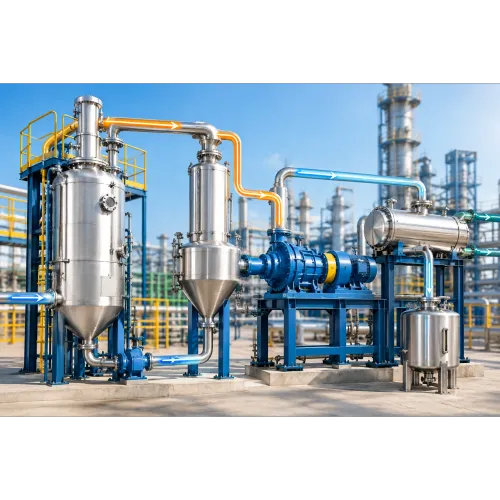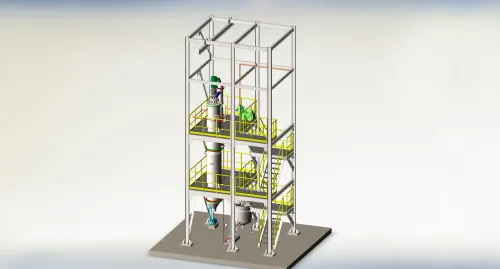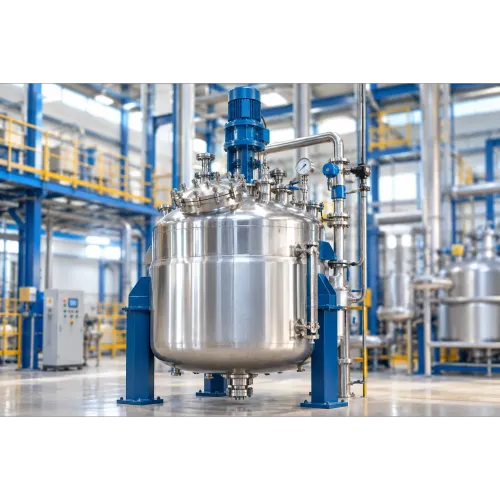

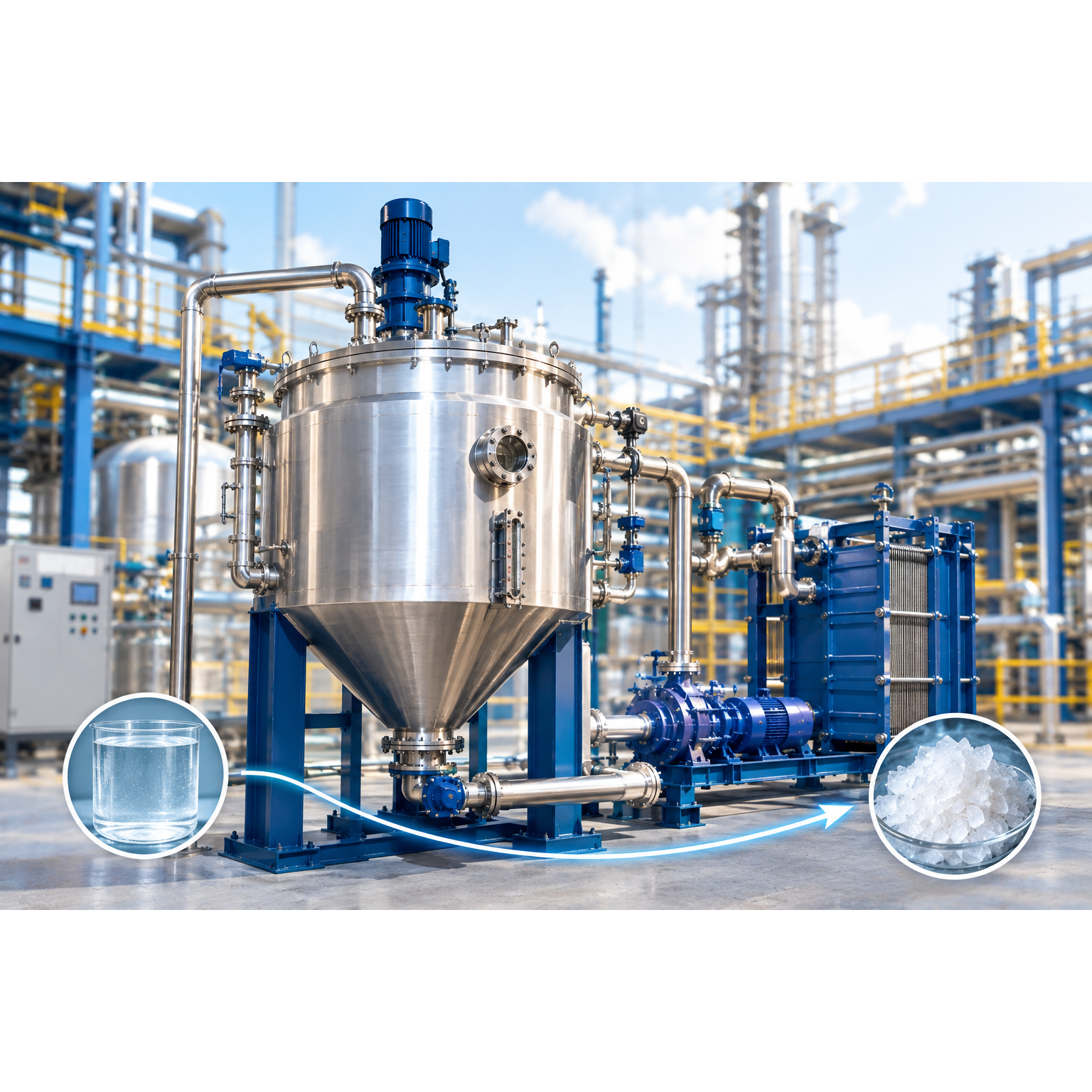
In many industrial processes, dissolved salts and minerals remain in solution even after evaporation and concentration. When further water removal is required, the process must be controlled carefully so that dissolved components form stable, recoverable crystals rather than uncontrolled deposits or scale.
This is where an industrial crystallizer becomes an important part of the process.
At CentPro Engineering, crystallization systems are engineered around the feed chemistry, solubility characteristics, required recovery, crystal properties and downstream solids-handling requirements. The objective is not simply to produce solids, but to control where, when and how crystals are formed.
Supersaturation: The Starting Point for Crystallization
Crystallization begins when a solution reaches supersaturation—a condition where the concentration of dissolved material exceeds its equilibrium solubility under the operating conditions.
Supersaturation can be created by evaporation, cooling, or a combination of process conditions.
Controlling this stage is critical. Excessive or uncontrolled supersaturation can result in rapid nucleation, fine crystals and unwanted scaling, while insufficient supersaturation may reduce the crystallization rate and overall recovery.
Crystal Growth and Product Quality
Once crystal nuclei are formed, dissolved material deposits onto their surfaces and the crystals begin to grow.
The rate of crystal growth influences particle size, shape and purity. For industrial applications, larger and more uniform crystals can be easier to separate, wash, transport and handle.
Process conditions such as temperature, concentration, circulation rate and residence time are therefore controlled to achieve the required crystal characteristics.
Circulation and Residence Time
Effective circulation is essential for maintaining consistent conditions throughout the crystallizer.
Proper circulation helps distribute heat, concentration and suspended crystals while reducing the risk of localized supersaturation and unwanted deposition on heat-transfer surfaces.
Residence time also plays an important role. Sufficient time must be provided for crystal growth and maturation before the slurry moves to the separation stage.
The required residence time depends on the material being crystallized and the desired crystal size and recovery.
Crystallization in ZLD Systems
Crystallizers are particularly relevant to Zero Liquid Discharge (ZLD) systems where the objective is to recover water while converting the remaining dissolved salts into manageable solids.
A typical thermal ZLD process may involve:
RO → MEE/MVR → Concentrated Brine → Crystallization → Solid-Liquid Separation
The crystallizer receives a highly concentrated stream after upstream water-recovery stages. The design must account for salt composition, solubility, boiling point elevation, viscosity, scaling tendency and final solids characteristics.
Depending on the process, crystallization can be integrated with technologies such as MEE, MVR/MVRE and ATFD.
Recovering Valuable Solids
Crystallization is not always about waste disposal. In suitable applications, controlled crystallization can enable the recovery of salts, chemicals or other process materials in a form that can be collected and further processed.
The value of the recovered product depends on its purity, crystal size, moisture content and separation efficiency.
CentPro Engineering evaluates the complete process—from feed concentration and supersaturation through crystal growth, slurry handling and final solids recovery—to develop a suitable crystallization solution.
Designing the Crystallizer Around the Process
There is no single crystallizer configuration suitable for every application. Feed chemistry, solubility curve, concentration, operating temperature, circulation requirements and desired product characteristics all influence the final design.
CentPro supports process industries with customised crystallization and evaporation solutions, integrating process engineering with equipment design, manufacturing and project execution.
Need a Crystallization Solution?
Share your feed composition, flow rate, concentration, major salts and required solids recovery with CentPro Engineering. Our process engineering team can evaluate the crystallization requirement and develop a suitable system for your application.
Enquire with CentPro Engineering for customised industrial crystallizers, salt recovery and ZLD solutions.
1. What is an industrial crystallizer?
An industrial crystallizer is process equipment used to convert dissolved materials in a concentrated solution into solid crystals through controlled supersaturation, nucleation and crystal growth.
2. Where are crystallizers used in ZLD systems?
Crystallizers are generally used toward the final stages of a ZLD system, after processes such as RO and MEE/MVR have removed most of the water and concentrated the remaining dissolved salts.
3. What is supersaturation in crystallization?
Supersaturation occurs when the concentration of a dissolved substance exceeds its equilibrium solubility under specific operating conditions. It provides the driving force for nucleation and crystal growth.
4. What factors affect crystal size and quality?
Important factors include supersaturation, temperature, circulation rate, residence time, feed composition and cooling or evaporation rate. Proper control of these parameters helps produce more consistent crystals.
5. What information is required to design a crystallizer?
Typical process information includes feed flow rate, chemical composition, TDS/concentration, major salts, solubility characteristics, operating temperature, required recovery and desired final crystal characteristics. These parameters help determine the appropriate crystallization process and equipment configuration.