
Beyond Wastewater Treatment: Engineering an Integrated MEE-MVR-Crystallizer ZLD Plant
As industrial water requirements continue to increase, wastewater management is moving beyond conventional treatment and disposal. Chemical, pharmaceutical, textile, specialty chemical, agrochemical, and other process industries are increasingly looking for solutions that can recover water, reduce wastewater volume, manage high-TDS streams, and minimize liquid discharge.
This is where an integrated Zero Liquid Discharge (ZLD) system becomes critical.
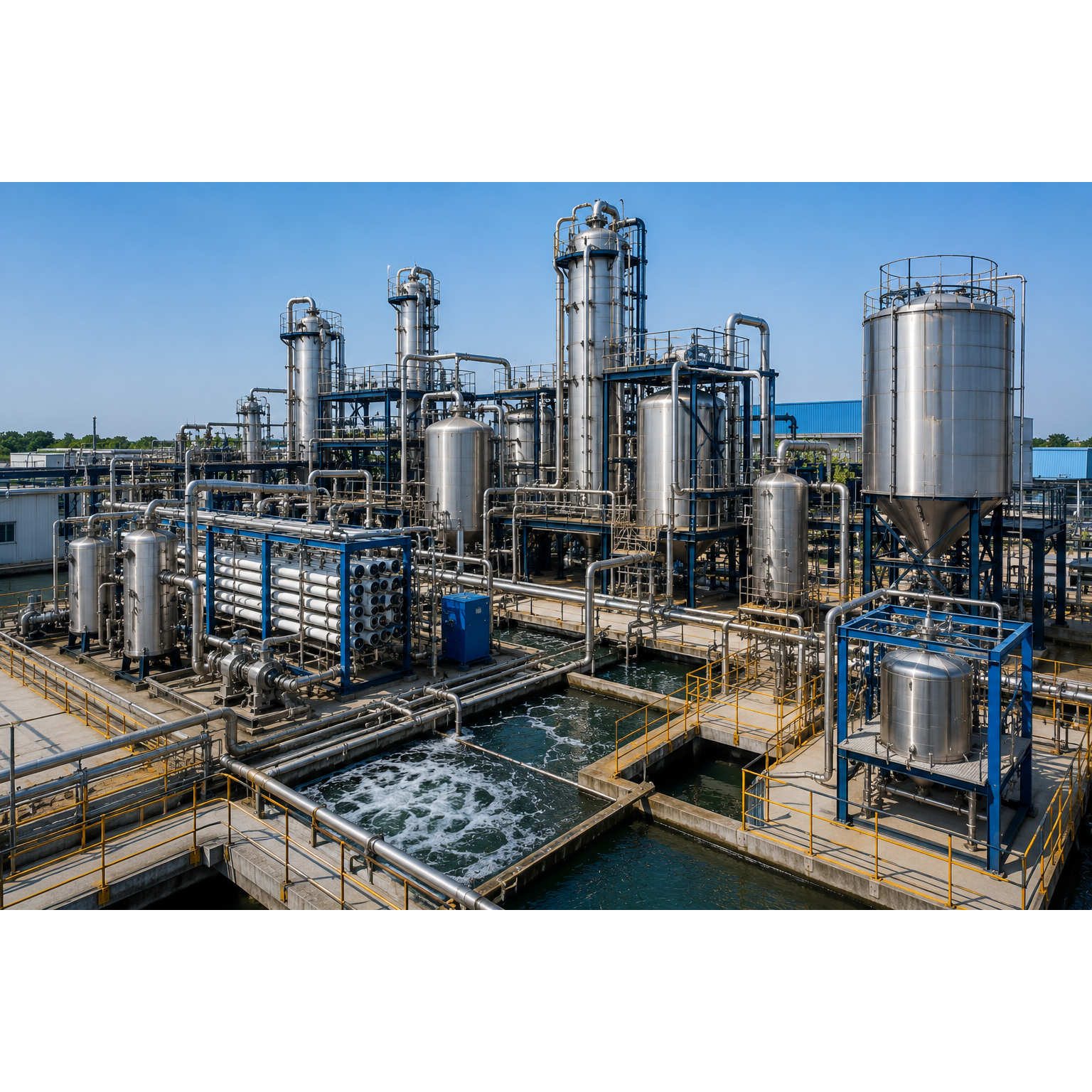
A modern ZLD plant is not a single piece of equipment. It is an integrated process system in which membrane technology, thermal evaporation, vapor recompression, crystallization, solid-liquid separation, condensate recovery, and automation work together to achieve maximum water recovery with controlled energy consumption.
CentPro Engineering Pvt. Ltd. designs and engineers integrated MEE + MVR + Crystallizer ZLD systems for industries dealing with high-TDS wastewater, RO reject, concentrated process streams, mother liquors, and challenging industrial effluents.
From RO Reject to Water Recovery
A typical integrated thermal ZLD process can follow the sequence:
RO Reject → MEE/MVR → Concentration → Crystallization → Salt Separation → Condensate Recovery → Water Reuse
The exact configuration depends on wastewater chemistry, flow rate, TDS, scaling potential, required recovery, available steam and electrical power, and the characteristics of the final concentrate.
The objective is simple: recover as much usable water as technically and economically practical while reducing the remaining liquid waste to a manageable solid form.
Stage 1: Reverse Osmosis and Feed Concentration
Reverse Osmosis (RO) is commonly used as an upstream water recovery stage. It can recover a significant portion of the wastewater as permeate while concentrating dissolved salts and other contaminants into the RO reject stream.
Instead of sending this concentrated reject directly for disposal, the reject can be routed to a thermal ZLD system for further concentration.
This reduces the volume entering the evaporator and can help optimize the overall thermal load of the plant.
Stage 2: Multiple Effect Evaporation
The concentrated RO reject enters the thermal evaporation section, where water is separated from dissolved solids through controlled evaporation.
A Multiple Effect Evaporator (MEE) improves thermal efficiency by utilizing vapor generated in one effect as the heating medium for the next effect. This cascading utilization of latent heat allows multiple stages of evaporation to operate with improved steam economy compared with a conventional single-effect arrangement.
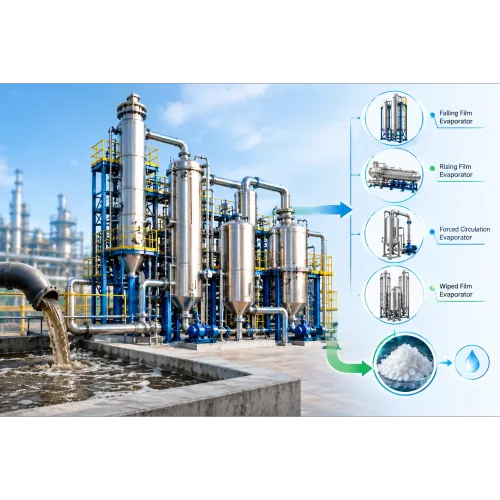
CentPro can engineer MEE systems using configurations such as:
Falling Film Evaporation
Forced Circulation Evaporation
Rising Film Evaporation
Mixed-flow configurations
The selection depends on feed properties, TDS, viscosity, scaling tendency, concentration ratio, and desired evaporation capacity.
Stage 3: MVR for Energy Optimization
Where electrical power is available and energy economics justify its use, Mechanical Vapor Recompression (MVR) can be integrated with the evaporation system.
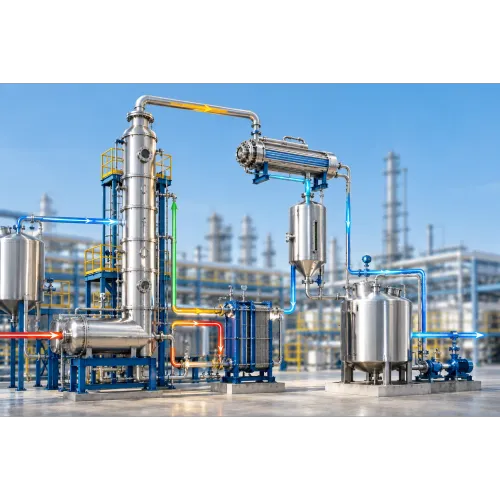
MVR captures generated vapor and mechanically compresses it to increase its pressure and temperature. The upgraded vapor is then reused as the heating medium.
Instead of continuously rejecting useful vapor energy, the system creates an internal energy-recovery loop.
Evaporation → Vapor Generation → Compression → Heat Reuse → Evaporation
The integration of MEE and MVR can therefore provide flexibility in balancing steam consumption, electrical power consumption, capital investment, and operating cost.
Technology selection should always be based on actual site economics and process conditions rather than assuming that MVR or MEE is universally better.
Stage 4: Thermal Concentration
As evaporation progresses, the dissolved solids concentration of the liquid increases. At higher concentrations, the process becomes increasingly sensitive to viscosity, scaling, boiling point elevation, heat-transfer performance, and circulation conditions.
This is why thermal ZLD systems require careful process engineering.
CentPro considers parameters including:
Feed TDS
COD and organic load
Chloride and sulphate concentration
Silica
Hardness
Viscosity
Scaling potential
Boiling point elevation
Concentration factor
Operating temperature
Steam availability
Electrical power availability
The evaporator configuration is then selected and engineered around these process characteristics.
Stage 5: Crystallization
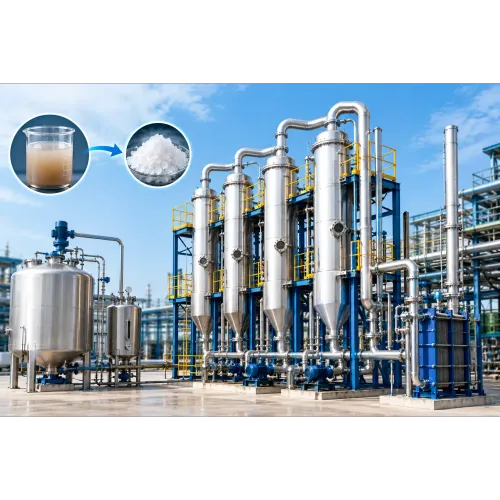
After sufficient thermal concentration, the remaining stream can approach saturation. Further evaporation can result in controlled formation of solid crystals.
This is where an industrial crystallizer becomes an important part of the ZLD process.
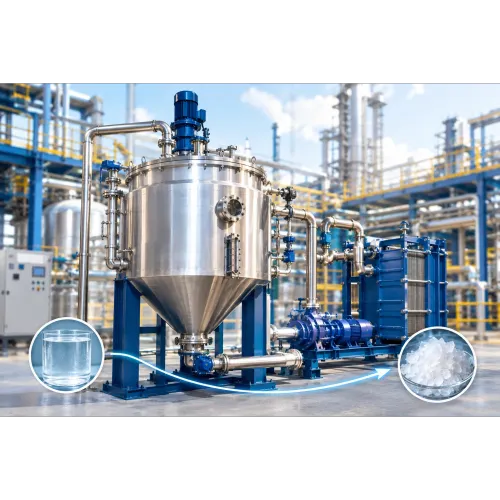
CentPro can engineer crystallization systems such as:
Forced Circulation Crystallizers
Vacuum Crystallizers
DTB Crystallizers
Evaporative Crystallizers
Crystallizer selection depends on the chemical composition, solubility characteristics, crystal growth requirements, solids loading, scaling behavior, and desired recovery.
Proper crystallizer design helps control crystal formation and improves downstream solid-liquid separation.
Stage 6: Salt Separation and Solid Management
The crystals generated in the crystallizer must be separated from the remaining liquid phase. Depending on the application, equipment such as centrifuges, filters, or other solid-liquid separation systems can be integrated.
The recovered solids may contain different salts depending on the original wastewater chemistry.
Effective salt management therefore requires consideration of:
Crystal characteristics
Moisture content
Solid purity
Handling requirements
Storage
Transportation
Disposal or potential recovery
The objective is to convert a difficult liquid waste stream into a more manageable solid stream.
Stage 7: Condensate Recovery and Water Reuse
One of the most valuable outputs from thermal ZLD is the recovered condensate.
During evaporation, water is converted into vapor and subsequently condensed. Depending on the feed characteristics and required reuse quality, the recovered condensate can undergo additional polishing or treatment before being returned to suitable plant applications.
This can create a circular water-management approach:
Wastewater → Treatment → Water Recovery → Polishing → Process Reuse
By reducing freshwater intake, industries can improve water efficiency while reducing dependence on external water sources.
Intelligent Automation for ZLD Performance
A complex MEE-MVR-crystallizer system requires accurate monitoring and control of multiple operating parameters.
CentPro can integrate PLC, SCADA, instrumentation, control valves, sensors, alarms, interlocks, and data logging into the ZLD system.
Critical parameters may include:
Temperature
Pressure
Vacuum
Flow
Level
Conductivity
Density
Steam consumption
Power consumption
Motor load
Differential pressure
Automation helps operators maintain stable operating conditions, identify abnormal trends, manage equipment safely, and optimize plant performance.
Engineering for Steam and Power Optimization
Energy consumption is one of the most important considerations in thermal ZLD.
CentPro evaluates the complete energy balance rather than optimizing individual equipment in isolation. Depending on the project, energy-saving measures can include:
Multiple-effect evaporation
Mechanical vapor recompression
Heat recovery
Feed preheating
Condensate recovery
Optimized circulation
Proper heat exchanger selection
Process heat integration
The optimum configuration depends on the relative cost and availability of steam, electricity, cooling utilities, and operating hours.
Applications
Integrated MEE-MVR-Crystallizer ZLD systems can be engineered for:
Chemical Manufacturing
Pharmaceutical and API Plants
Textile Processing
Dyes and Pigments
Specialty Chemicals
Agrochemical Manufacturing
Petrochemical Industries
High-TDS Industrial Effluent
RO Reject Treatment
Concentrated Mother Liquors
Industrial Brine Management
CentPro's Integrated ZLD Capability
CentPro Engineering brings together process engineering, evaporation technology, MVR systems, crystallization, equipment manufacturing, automation, and project execution to develop customized ZLD solutions.
Our approach starts with understanding the wastewater rather than selecting equipment first. Feed characterization, mass balance, heat balance, utility availability, recovery targets, concentrate behavior, and downstream solid handling are evaluated to develop an appropriate process configuration.
From individual thermal equipment to a complete MEE + MVR + Crystallizer ZLD plant, CentPro can support the project through engineering, manufacturing, integration, installation, commissioning, and technical support.
Moving Towards Circular Industrial Water Management
The future of industrial wastewater management is moving toward maximum recovery and minimum waste. An intelligently engineered ZLD system can help industries recover water, reduce liquid discharge, manage high-TDS streams, and improve overall resource efficiency.
For facilities where conventional treatment and RO alone cannot achieve the required recovery, an integrated MEE-MVR-Crystallizer configuration provides a powerful thermal treatment and resource-recovery pathway.
CentPro's objective is not simply to eliminate liquid discharge—it is to engineer a reliable, energy-conscious, automated, and process-specific water recovery system that supports long-term industrial operations.