
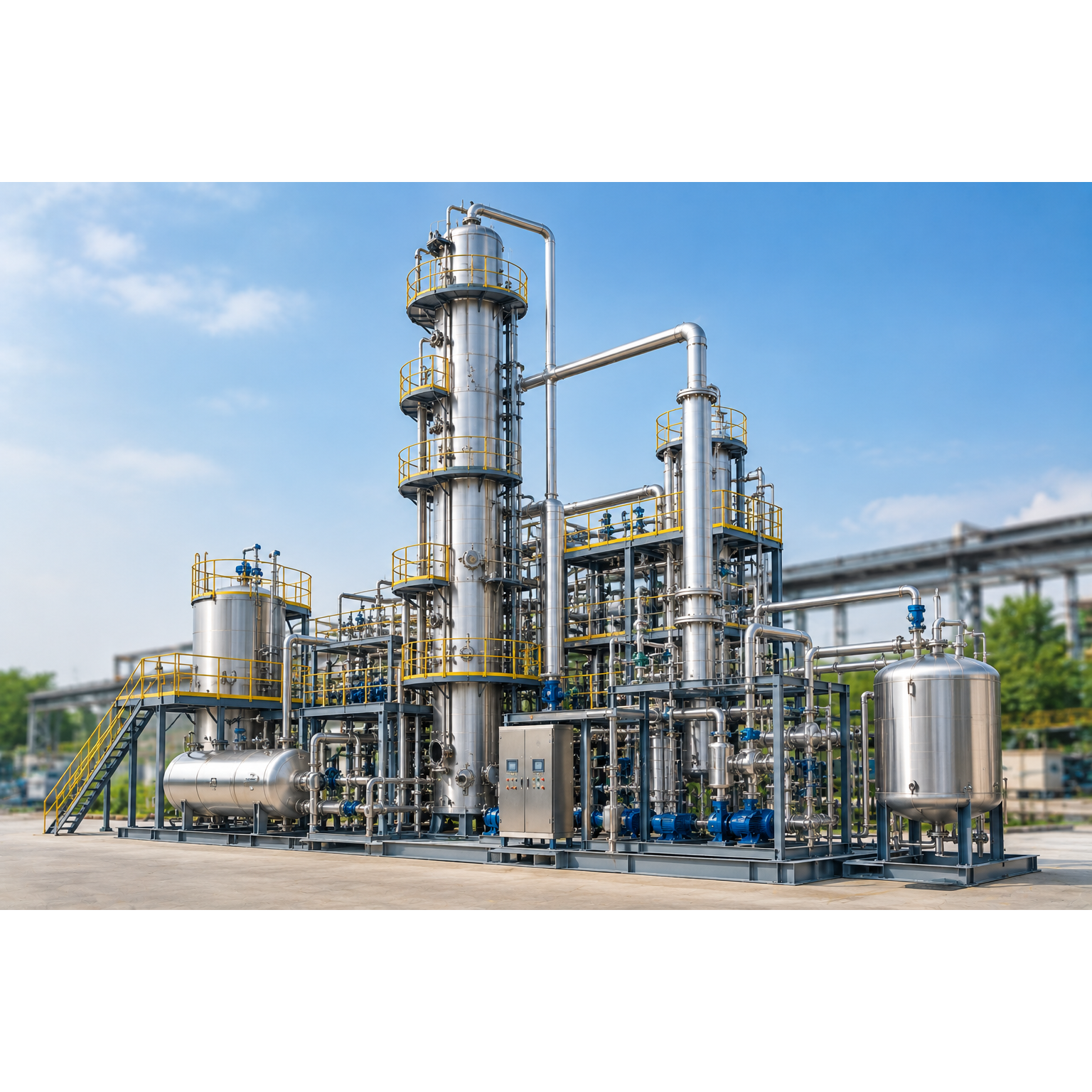
Recovering Solvent, Reducing Waste: Engineering Closed-Loop Solvent Recovery
Solvents play an essential role in chemical, pharmaceutical, API, specialty chemical, paint, resin, adhesive, and other process industries. However, solvent-containing process streams can represent a significant operating cost when valuable solvents are lost with wastewater, process residues, or spent mixtures.
A properly engineered solvent recovery and distillation plant can convert these losses into an opportunity for solvent recycling, waste reduction, and improved process economics.
CentPro Engineering Pvt. Ltd. designs and manufactures complete solvent recovery systems and industrial distillation plants, integrating distillation columns, reboilers, condensers, receivers, vacuum systems, heat exchangers, pumps, instrumentation, and automation into a coordinated process solution.
Our engineering approach focuses on achieving the required solvent purity and recovery efficiency while optimizing energy consumption, equipment configuration, safety, and maintainability.
How a Solvent Recovery Plant Works
A typical solvent recovery process can be configured as:
Solvent-Bearing Feed → Pre-Treatment → Distillation → Condensation → Solvent Collection → Residue Handling
The exact process configuration depends on the solvent mixture, boiling points, feed composition, solids content, thermal sensitivity, required purity, and recovery target.
The objective is to separate the desired solvent from contaminants and recover it in a condition suitable for reuse or further processing.
Solvent Recovery Through Distillation
Distillation is one of the most widely used separation technologies for recovering solvents because it utilizes differences in the volatility of individual components.
During the process, the solvent mixture is heated in a reboiler. More volatile components preferentially move into the vapor phase and rise through the distillation system. The vapor is subsequently condensed and collected as recovered solvent.
For higher separation requirements, the system can incorporate:
Packed distillation columns
Tray columns
Reboilers
Condensers
Reflux systems
Receivers
Vacuum systems
Heat exchangers
Automated control systems
The number of theoretical stages, reflux ratio, operating pressure, heat duty, and column configuration are selected according to the required separation performance.
Vacuum Distillation for Heat-Sensitive Solvents
Certain solvents and process mixtures can be sensitive to high operating temperatures. Vacuum distillation can be considered in such applications.
By reducing operating pressure, the boiling temperature of the mixture can also be reduced. This can help limit thermal exposure and support recovery of solvents that may otherwise require higher temperatures under atmospheric operation.
Vacuum distillation can be particularly useful for selected pharmaceutical, specialty chemical, and high-value process applications.
The appropriate vacuum level and equipment configuration depend on the solvent properties, feed composition, required recovery, and process constraints.
Improving Solvent Recovery Efficiency
Maximum solvent recovery is not achieved simply by installing a larger distillation column. Recovery efficiency depends on the complete process design.
CentPro evaluates factors including:
Feed composition
Solvent concentration
Relative volatility
Boiling point
Required solvent purity
Reflux ratio
Operating pressure
Feed temperature
Heat duty
Condensation requirements
Residue characteristics
Desired recovery percentage
This process-based approach helps determine the appropriate equipment configuration and operating strategy.
Energy Optimization in Solvent Recovery
Energy consumption can be a significant part of solvent recovery operating costs, particularly for continuous industrial systems.
CentPro considers energy integration opportunities such as:
Feed preheating
Condensate heat recovery
Reboiler optimization
Heat exchanger integration
Vapor heat recovery
Appropriate vacuum operation
Optimized reflux
Thermal integration with existing plant utilities
Where practical, recovered heat from one part of the process can be utilized elsewhere in the plant, reducing unnecessary energy losses.
Solvent Purity and Product Recovery
Recovered solvent quality is often just as important as recovery quantity.
Depending on the application, recovered solvent may need to meet specific purity requirements before being reused in production. Distillation design therefore needs to account for the separation between the target solvent and impurities.
CentPro can engineer systems around the required recovery specification, whether the objective is:
Maximum solvent recovery → Reuse-grade solvent → High-purity solvent recovery
The appropriate separation configuration depends on the feed mixture and final product specification.
Condensation and Solvent Collection
After separation in the distillation column, solvent-rich vapor passes through a condenser where it is converted back into liquid form.
The condenser and receiver system must be designed considering:
Vapor flow rate
Condensation temperature
Cooling medium
Operating pressure
Solvent properties
Heat-transfer duty
Required recovery efficiency
Effective condensation is essential for minimizing solvent losses and ensuring stable operation of the recovery plant.
Solvent Recovery from Different Process Streams
CentPro's solvent recovery systems can be engineered for applications involving:
Spent solvents
Solvent-water mixtures
Pharmaceutical process streams
API manufacturing residues
Chemical process waste
Mother liquors
Reaction residues
Washing solvents
Cleaning solvents
Paint and coating solvents
Resin manufacturing streams
Specialty chemical process streams
The treatment configuration is customized according to the chemical and physical characteristics of the feed.
Safety-Critical Engineering
Many industrial solvents are flammable, volatile, or hazardous. Therefore, solvent recovery plants require careful consideration of process safety, equipment design, electrical classification, ventilation, pressure control, temperature control, leak prevention, grounding, and appropriate instrumentation.
Depending on the application and applicable site requirements, the plant can incorporate suitable safety systems, alarms, interlocks, pressure protection, and automated shutdown logic.
Safety requirements should always be finalized according to the actual solvent properties, plant conditions, applicable codes, and the client's process safety standards.
Integration with Existing Production Plants
A solvent recovery system is often installed as part of an existing chemical or pharmaceutical facility. This makes plant integration an important part of the engineering process.
CentPro can design recovery systems around existing:
Reactors
Storage tanks
Process vessels
Heat exchangers
Utility systems
Vacuum systems
Piping networks
Automation systems
Solvent storage facilities
This allows the recovery plant to operate as an integrated part of the manufacturing process rather than as an isolated treatment unit.
Complete Solvent Recovery Plant
A complete system can include:
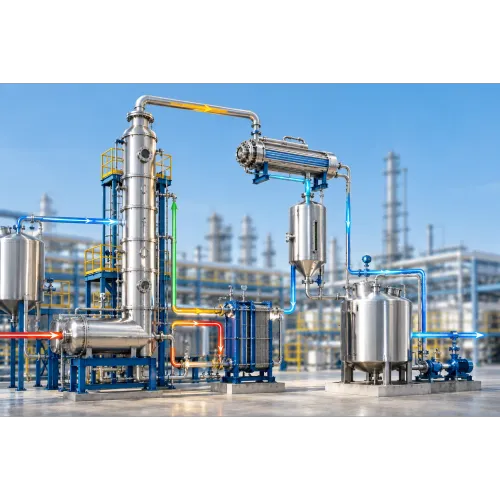
Feed Tank → Feed Pump → Preheater → Distillation Column → Reboiler → Condenser → Receiver → Recovered Solvent Storage
Additional equipment such as vacuum systems, residue tanks, heat exchangers, pumps, instrumentation, control panels, and automated process controls can be incorporated according to project requirements.
Applications
Solvent recovery and distillation systems can be engineered for:
Pharmaceutical Manufacturing
API Manufacturing
Chemical Industries
Specialty Chemicals
Agrochemical Manufacturing
Paint Manufacturing
Coatings
Resins
Adhesives
Petrochemical Processes
Industrial Chemical Processing
Environmental and Economic Benefits
Recovering solvents can provide benefits beyond waste reduction.
A properly engineered solvent recovery plant can help industries:
Reduce fresh solvent consumption
Recover valuable process chemicals
Reduce solvent disposal volumes
Minimize production losses
Improve resource utilization
Reduce waste-management costs
Support circular process operations
Improve overall process economics
Instead of treating solvent-containing streams purely as waste, industries can recover valuable materials and return them to the production cycle wherever technically feasible.
CentPro's Solvent Recovery & Distillation Expertise
CentPro Engineering combines process engineering, distillation technology, equipment manufacturing, heat-transfer engineering, automation, and turnkey project execution to develop customized solvent recovery plants.
Our scope can extend from individual distillation equipment to a complete turnkey solvent recovery and distillation plant, including engineering, manufacturing, piping, instrumentation, automation, installation, commissioning, and integration with existing process systems.
The goal is to engineer a recovery system that delivers the required solvent purity, recovery efficiency, energy performance, operational reliability, and safety for the specific application.
Frequently Asked Questions
1. What is a solvent recovery plant?
A solvent recovery plant is an industrial process system designed to separate and recover reusable solvents from solvent-containing mixtures, process residues, wastewater, or spent solvents. Distillation is commonly used because different components can be separated based on their volatility.
2. Which industries use solvent recovery systems?
Solvent recovery systems are widely applicable in pharmaceutical, API, chemical, specialty chemical, agrochemical, paint, coating, resin, adhesive, and petrochemical industries, depending on the composition of the process stream.
3. Can solvent recovery be integrated with an existing chemical plant?
Yes. A solvent recovery system can be engineered around existing reactors, storage tanks, utilities, piping, vacuum systems, and production equipment. Proper integration requires evaluation of feed characteristics, flow rates, utilities, operating conditions, and available plant space.
4. When is vacuum distillation preferred?
Vacuum distillation can be considered when a process requires lower boiling temperatures, particularly for selected heat-sensitive materials or solvent mixtures. The appropriate operating pressure depends on the solvent properties, feed composition, required separation, and process temperature limitations.
5. How does solvent recovery reduce operating costs?
Recovering and reusing solvent can reduce fresh-solvent purchases and decrease the volume of solvent-containing waste requiring disposal. Additional savings may be possible through heat integration, feed preheating, optimized distillation, and efficient condensation.