
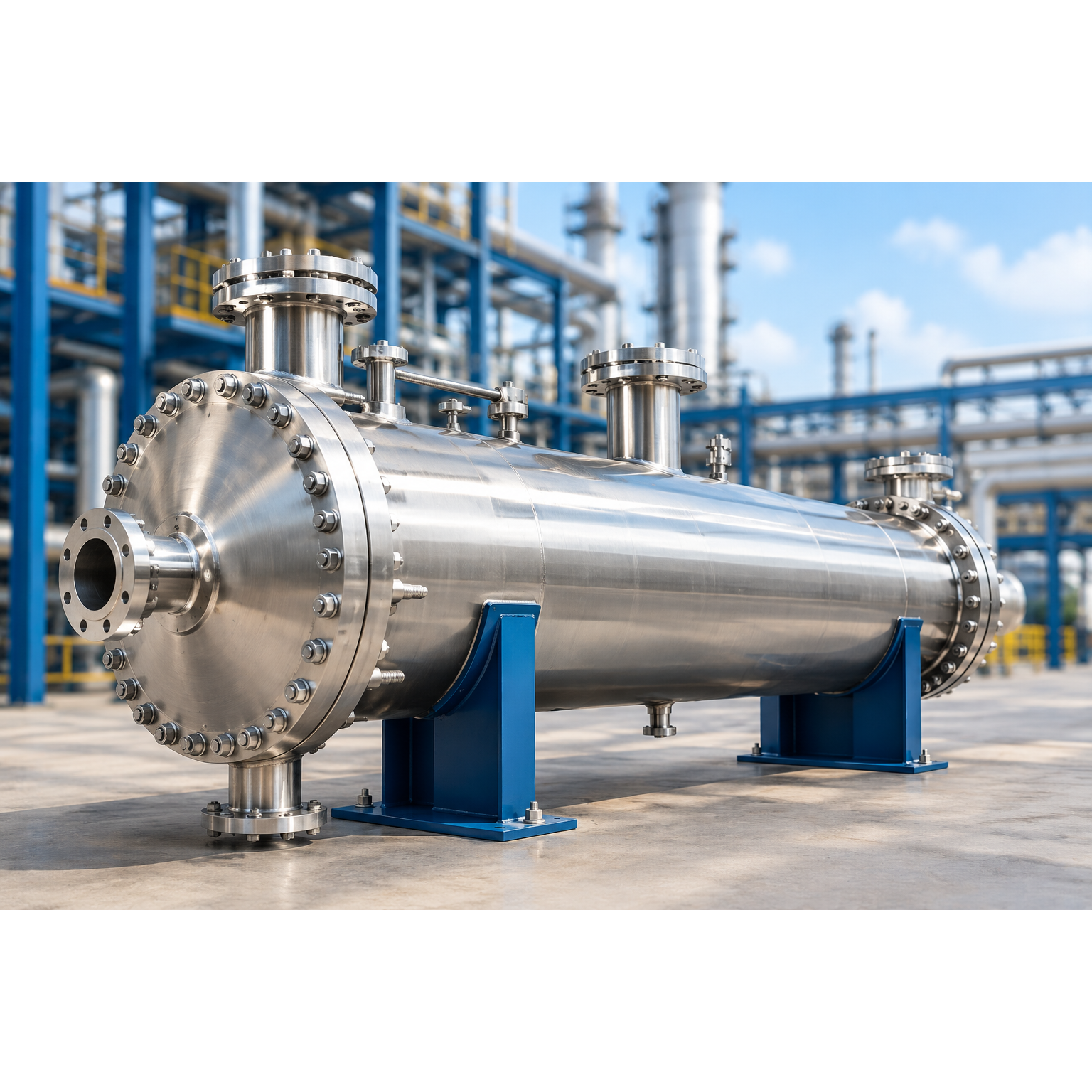
A heat exchanger is not selected simply by looking at the required heat-transfer area. The right design starts with understanding the process, fluids, operating conditions and heat duty.
At CentPro Engineering, we engineer customised heat exchanger solutions for chemical, pharmaceutical, petrochemical, food, environmental and process industries. Our approach considers thermal performance, material compatibility, fouling, pressure drop, maintainability and operating conditions before finalising the equipment design.
Heat Duty and Temperature Approach
The first step in heat exchanger design is understanding the required heat duty—how much heat needs to be transferred between the process streams.
The inlet and outlet temperatures of both fluids determine the available temperature driving force. A suitable temperature approach helps establish the required heat-transfer area while balancing equipment size, utility consumption and overall project cost.
Whether the application involves process heating, cooling, condensation, evaporation or heat recovery, the exchanger is designed around the actual process requirement.
Fluid Properties Influence Design
Different fluids behave differently during heat transfer. Viscosity, density, specific heat, thermal conductivity, phase change characteristics and flow rate all influence exchanger performance.
For example, highly viscous fluids may require a different flow arrangement or exchanger configuration compared with low-viscosity liquids. Applications involving steam condensation, boiling or gas cooling also require specific thermal and mechanical considerations.
Understanding these properties helps determine the appropriate exchanger type, flow arrangement and heat-transfer surface.
Material of Construction Matters
The Material of Construction (MOC) must be compatible with the process fluid and operating environment.
Depending on the application, CentPro works with materials such as SS304, SS316L, Duplex, Super Duplex and Titanium, where required. Material selection considers corrosion resistance, temperature, pressure and chemical compatibility to support reliable long-term operation.
Managing Fouling and Pressure Drop
Fouling can significantly reduce heat-transfer performance over time. Deposits, suspended solids, scaling and process contaminants can increase thermal resistance and reduce exchanger efficiency.
A well-engineered exchanger considers fouling tendency, cleaning requirements, fluid velocity and pressure drop during design. This helps maintain performance while reducing unnecessary maintenance and operating interruptions.
Heat Exchanger Engineering Beyond Thermal Design
An effective heat exchanger must perform reliably under actual plant conditions. Mechanical design, nozzle orientation, piping integration, accessibility, inspection and maintenance requirements are therefore considered along with thermal performance.
CentPro Engineering provides integrated engineering and manufacturing solutions for shell-and-tube heat exchangers, process heat exchangers, condensers, coolers, heaters and heat recovery systems.
From process calculations and thermal design to mechanical engineering, fabrication, testing and commissioning, we support projects with a complete engineering approach.
Looking for the Right Heat Exchanger?
Share your process fluid, flow rate, inlet and outlet temperatures, operating pressure and required heat duty with CentPro Engineering. Our engineering team can evaluate your application and develop a suitable heat exchanger solution.
Enquire with CentPro Engineering for customised heat exchanger design and process heat-transfer solutions.